Original price was: KSh500.KSh499Current price is: KSh499.
Download Principles of Taxation April 2026 ATD Level III Answers
Description
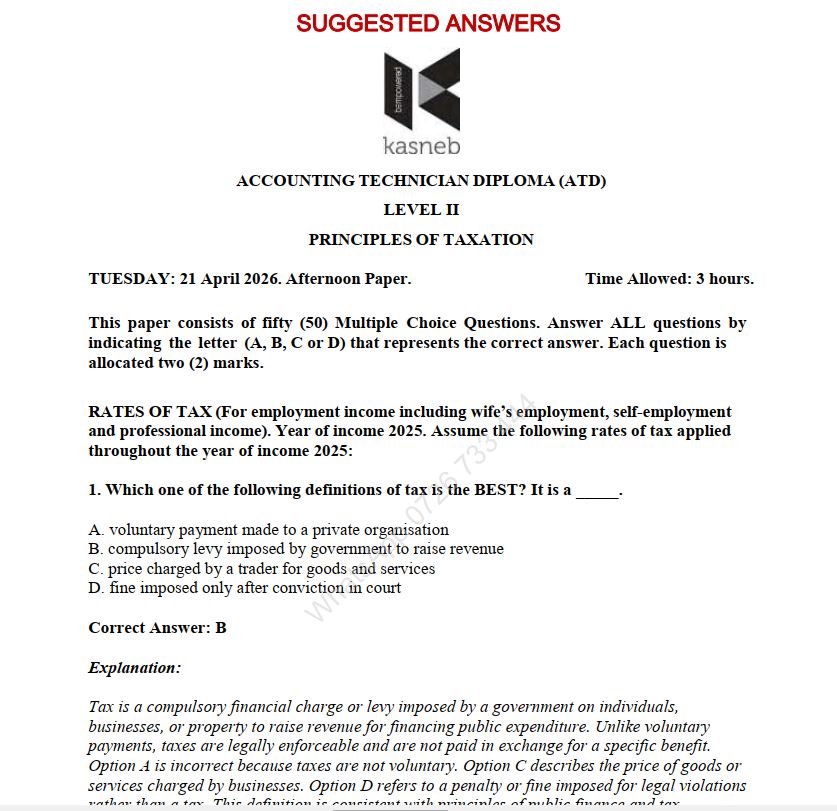
ACCOUNTING TECHNICIAN DIPLOMA (ATD) LEVEL II
PRINCIPLES OF TAXATION
TUESDAY: 21 April 2026. Afternoon Paper. Time Allowed: 3 hours.
This paper consists of fifty (50) Multiple Choice Questions. Answer ALL questions by indicating the letter (A, B, C or D) that represents the correct answer. Each question is allocated two (2) marks.
RATES OF TAX (For employment income including wife’s employment, self-employment and professional income). Year of income 2025. Assume the following rates of tax applied throughout the year of income 2025:
1. Which one of the following definitions of tax is the BEST? It is a .
A. voluntary payment made to a private organisation
B. compulsory levy imposed by government to raise revenue
C. price charged by a trader for goods and services
D. fine imposed only after conviction in court (2 marks)
2. Which one of the following statements is a purpose of taxation in Kenya?
A. To eliminate all imports permanently
B. To abolish government borrowing automatically
C. To replace accounting standards
D. To finance public expenditure and provide public goods and services (2 marks)
3. Which one of the following principles of taxation is BEST described as certainty?
A. The tax payable should be clear, definite and not arbitrary
B. Taxpayers should pay tax at the time and in the manner most convenient
C. Tax should encourage only all sector of the economy
D. Tax should be collected in cash and through bank (2 marks)
4. A tax system is progressive when the rate of tax .
A. decreases as the tax base increases
B. is constant for all taxpayers
C. increases as the tax base increases
D. depends on the quantity imported (2 marks)
5. Which one of the following statements BEST describes tax impact?
A. The person who ultimately bears the burden of the tax after shifting
B. The amount of tax withheld at source
C. The process of filing returns on iTax
D. The person on whom the tax is first imposed by law (2 marks)
6. Forward shifting of tax occurs when the .
A. tax burden is passed from the producer to the consumer through higher prices
B. producer bears the tax burden due to inelastic demand
C. tax burden is transferred by retailers to producer through lower supply prices
D. tax is shifted from one country to another country (2 marks)
7. Which one of the following statements is a statutory deduction from employment income?
A. Dividends received from a resident company
B. National Social Security Fund contributions
C. Gross rent received from residential property
D. Capital gains on sale of land (2 marks)
8. Which one of the following benefits is a non-cash benefit that may arise from employment?
A. Basic salary
B. Reimbursement of business travel supported by receipts
C. Overtime payment
D. Use of an employer’s motor vehicle for private purposes (2 marks)
9. Which one of the following statements is an advantage of withholding tax?
A. It increases tax evasion
B. It eliminates the need to keep records
C. It improves collection by taxing income at source
D. It applies only to exempt income (2 marks)
10. Which one of the following statements is an obligation of a VAT registered person under the Value Added Tax Act, 2013?
A. To charge VAT on exempt supplies
B. To pay VAT for all suppliers
C. To file customs entries for local purchases
D. To keep proper VAT records and submit VAT returns as required (2 marks)
11. A zero-rated supply for Value Added Tax (VAT) purposes means that .
A. VAT is charged at 0% and input VAT relating to the supply is claimable
B. VAT is not charged and input VAT is not claimable
C. VAT is charged at 16% and input VAT is not claimable
D. VAT is charged at 16% and input VAT is claimable (2 marks)
12. Under the East African Community Customs Management Act, 2017, which one of the following documents primarily evidences shipment of goods by sea?
A. Bill of lading
B. PIN certificate
C. Bill of payment
D. Tax compliance certificate (2 marks)
13. Which one of the following statements BEST describes restricted goods under customs control?
A. Goods that are not subject to customs control and can be imported any time
B. Goods that are exempt from all taxes
C. Goods that must always be destroyed upon entry under custom supervision
D. Goods whose importation or exportation is allowed only subject to specified conditions (2 marks)
14. Under the Tax Procedures Act (Cap. 469B), which one of the following statements is a function or power of the Commissioner in tax administration?
A. To set taxation standards for companies
B. To make assessments and administer tax laws as provided under the law
C. To approve all county levies as and when necessary
D. To determine employment contracts and tax payable (2 marks)
15. Electronic Tax Invoice requirements in Kenya are anchored on .
A. Electronic Tax Invoice Regulations, 2020
B. Public Finance Management Act, 2012
C. The Customs and Excise Duty Act
D. Public Procurement and Asset Disposal Act, 2015 (2 marks)
Use the following information to answer Question 16 to Question 20.
Mutiso Kilonzo is the operations supervisor of Delta Engineering Ltd., a resident manufacturing company based in Athi River. The company processes payroll monthly and grants some benefits in kind to senior employees. Unless stated otherwise, assume every benefit provided is taxable and that Mutiso served for the full year ended 31 December 2025.
Additional information:
• Basic salary was Sh.142,000 per month and entertainment allowance was Sh.18,000 per month, both paid through payroll.
• The employer rented a furnished house for him from an unrelated landlord at Sh.36,000 per month. The market rental value of a comparable house was Sh.42,000 per month.
• Furniture placed in the house had originally cost the employer Sh.360,000 and remained available to Mutiso throughout the year.
• He was also provided with a saloon car of 1,800cc for use for the whole year.
• On 1 January 2025 he obtained an employer loan of Sh.2,400,000 at 4% per annum. The loan remained outstanding all year while the prescribed market rate was 10% per annum.
• Mutiso contributed Sh.8,000 per month to a qualifying life insurance policy and Sh.10,000 per month to a registered HOSP. No other pension or deductible contribution was made.
16. Compute the annual taxable housing benefit.
A. Sh.288,000
B. Sh.432,000
C. Sh.504,000
D. Sh.216,000 (2 marks)
17. Determine the annual taxable furniture benefit.
A. Sh.36,000
B. Sh.43,200
C. Sh.72,000
D. Sh.86,400 (2 marks)
18. Determine the annual low interest benefit arising from the employer loan.
A. Sh.96,000
B. Sh.120,000
C. Sh.144,000
D. Sh.240,000 (2 marks)
19. Compute the annual HOSP deduction claimable.
A. Sh.120,000
B. Sh.96,000
C. Sh.80,000
D. Sh.60,000 (2 marks)
20. Compute the net PAYE payable for the year, after personal relief and insurance relief.
A. Sh.681,880
B. Sh.653080
C. Sh. 609,880
D. Sh.624,280 (2 marks)
Use the following information to answer Question 21 to Question 25.
Naomi Chebet is employed by AgroFresh Ltd. as a field supervisor on the employer’s tea plantation in Kericho. Because of the remote location, some facilities are provided within the plantation compound. Assume Naomi is taxable under PAYE and worked for the full year ended 31 December 2025.
• Basic salary was Sh.96,000 per month and acting allowance was Sh.14,000 per month for the whole year.
• She received a cash bonus of Sh.120,000 in December 2025.
• She occupied an employer-owned house on the plantation throughout the year and enjoyed communal water and electricity supplied by the employer.
• A Land Cruiser was provided by employer from 1 July 2025.
• Naomi also paid interest of Sh.410,000 during the year on a mortgage loan from a qualifying financial institution to acquire her own owner-occupied residential house in Nakuru.
• She made no life insurance contribution and received no other benefit or reimbursement during the year.
21. Compute The annual taxable benefit for water and electricity.
A. Sh.24,000
B. Sh.13,200
C. Sh.18,000
D. Sh.10,800 (2 marks)
22. Determine the annual motor vehicle benefit.
A. Sh.86,400
B. Sh.50,400
C. Sh.43,200
D. Sh.36,000 (2 marks)
23. Compute the allowable mortgage interest deduction for the year.
A. Sh.410,000
B. Sh.320,000
C. Sh.360,000
D. Sh.240,000 (2 marks)
24. Compute Naomi Chebet’s taxable employment income for the year .
A. Sh.1,640,400
B. Sh.1,340,400
C. Sh.1,483,600
D. Sh.1,280,400 (2 marks)
25. Determine the net PAYE payable for the year.
A. Sh. 292,720
B. Sh. 339,520
C. Sh. 310,720
D. Sh. 296,320 (2 marks)
Use the following information to answer Question 26 to Question 30.
Amani Advisory Ltd. is a resident management consultancy company. For the year ended 31 December 2025, the draft statement of profit or loss showed a net accounting profit of Sh.4,286,000 after charging or crediting the items below. Unless otherwise stated, all amounts had already been taken into account in arriving at the accounting profit.
Depreciation on office equipment and motor vehicles: Sh.240,000.
• Goodwill amortisation: Sh.80,000.
• General provision for bad debts: Sh.96,000.
• Subscription to the chamber of commerce: Sh.54,000.
• Legal fees incurred to recover trade debts from clients: Sh.84,000.
• Directors’ Christmas party held at a city hotel: Sh.120,000.
• Donation to a local football club that is not a qualifying charitable institution: Sh.60,000.
• The company also earned professional fees of Sh.240,000 from a resident client. Withholding tax was deducted at source at the prescribed rate. Instalment tax already paid during the year amounted to Sh.1,100,000 which was not included in arriving at the accounting profit above.
26. Calculate the total non-allowable expenses for tax purposes to be added back.
A. Sh.458,000
B. Sh.542,000
C. Sh.596,000
D. Sh.680,000 (2 marks)
27. Compute the total allowable expenses from the listed items.
A. Sh.138,000
B. Sh.150,000
C. Sh.114,000
D. Sh.54,000 (2 marks)
28. Compute the adjusted taxable profit for the year.
A. Sh.4,744,000
B. Sh.4,882,000
C. Sh.4,734,000
D. Sh.4,690,000 (2 marks)
29. Determine the withholding tax credit on the professional fees .
A. Sh.24,000
B. Sh.18,000
C. Sh.12,000
D. Sh.9,000 (2 marks)
30. Determine the balance of corporation tax payable after deducting instalment tax and withholding tax credit.
A. Sh.364,600
B. Sh.352,600
C. Sh.340,600
D. Sh.316,600 (2 marks)
Use the following information to answer Question 31 to Question 35.
Metro Office Supplies Ltd. is a VAT-registered trader dealing in office desks, printers and stationery. The company accounts for VAT on the invoice basis and files monthly VAT returns. The following transactions relate to the month of March 2025 and are stated exclusive of VAT unless otherwise indicated.
• Standard-rated local sales to ordinary customers: Sh.2,400,000.
• Standard-rated local sales to appointed VAT withholding agents: Sh.1,160,000.
• Export sales supported by proper customs documentation: Sh.640,000.
• Local purchases for resale from VAT-registered suppliers: Sh.1,520,000.
• Consultancy services received from a resident consultant: Sh.180,000.
• Stationery and printing for business use: Sh.90,000.
• Catering for a staff seminar held to discuss sales strategy: Sh.75,000.
• Assume all qualifying supplies are taxable at 16%, valid electronic tax invoices are available where relevant and VAT withholding agents applied the prescribed withholding mechanism on the relevant sales.
31. Compute the total taxable supplies for the month.
A. Sh.3,560,000
B. Sh.4,200,000
C. Sh.4,125,000
D. Sh.4,560,000 (2 marks)
32. Determine the output VAT for the month.
A. Sh.569,600
B. Sh.672,000
C. Sh.460,800
D. Sh.665,600 (2 marks)
33. Compute the allowable input VAT for the month.
A. Sh.298,400
B. Sh.274,400
C. Sh.286,400
D. Sh.271,600 (2 marks)
34. Determine the VAT withheld by the VAT withholding agents.
A. Sh.18,560
B. Sh.23,200
C. Sh.29,696
D. Sh.37,120 (2 marks)
35. Determine the net VAT payable to the revenue authority.
A. Sh.260,000
B. Sh.283,200
C. Sh.306,400
D. Sh.547,200 (2 marks)
Use the following information to answer Question 36 to Question 40.
BluePeak Foods Ltd. commenced manufacturing operations on 1 January 2025. In setting up the business, the company acquired several capital assets for production, administration and internal logistics. The following capital expenditure was incurred during the year ended 31 December 2025:
• Imported processing machinery: cost Sh.3,200,000; freight Sh.192,000; insurance Sh.128,000; installation costs Sh.180,000.
• Import duty on the machinery was chargeable at 25% of cost, freight and insurance.
• Hotel building used as a staff training and catering facility: Sh.8,400,000.
• Commercial office block used for administration: Sh.3,600,000.
• Computers used in finance and stores departments: Sh.960,000.
• Forklift used inside the factory and warehouse: Sh.1,440,000.
• All assets were first used in the business immediately they were acquired and none was disposed of during the year.
36. Compute the qualifying cost of the imported processing machinery.
A. Sh.4,400,000
B. Sh.4,580,000
C. Sh.4,760,000
D. Sh.4,888,000 (2 marks)
37. Compute the investment allowance on the processing machinery for the year.
A. Sh.1,145,000
B. Sh.2,290,000
C. Sh.1,374,000
D. Sh.915,000 (2 marks)
38. Determine the investment allowance on the hotel building for the year.
A. Sh.840,000
B. Sh.2,100,000
C. Sh.4,200,000
D. Sh.3,360,000 (2 marks)
39. Compute the investment allowance on the commercial office block for the year.
A. Sh.900,000
B. Sh.720,000
C. Sh.360,000
D. Sh.180,000 (2 marks)
40. The total investment allowance claimable for the year is.
A. Sh.7,450,000
B. Sh.7,090,000
C. Sh.6,850,000
D. Sh.5,810,000 (2 marks)
Use the following information to answer Question 41 to Question 45.
Grace Wambui owns a block of residential rental flats in Nairobi that was fully let throughout the year ended 31 December 2025. Rental collections were banked in full and gross rent received during the year amounted to Sh.3,600,000. In managing the property, she incurred the following expenditure:
• Repairs to leaking plumbing and damaged doors: Sh.180,000.
• Caretaker wages: Sh.144,000.
• Land rates: Sh.96,000.
• Repainting of the flats after tenants vacated: Sh.210,000.
• Extension of two additional rooms to create more accommodation space: Sh.540,000.
• During the year, a residential rental income withholding agent deducted tax at the prescribed rate from the gross rent collected.
• Separately, on 30 September 2025 Grace sold an urban investment plot for Sh.9,400,000. She had bought the plot for Sh.6,800,000 and incurred transfer and legal costs of Sh.260,000 on disposal.
• Assume the plot is a chargeable asset and that stamp duty on transfer is computed at the urban property rate.
41. Compute the taxable rental income for the year.
A. Sh.2,430,000
B. Sh.2,970,000
C. Sh.3,066,000
D. Sh.3,600,000 (2 marks)
42. Compute the residential rental withholding tax deducted during the year
A. Sh.216,000
B. Sh.225,000
C. Sh.270,000
D. Sh.297,000 (2 marks)
43. Determine the chargeable capital gain on disposal of the plot
A. Sh.2,600,000
B. Sh.2,340,000
C. Sh.2,080,000
D. Sh.2,470,000 (2 marks)
44. Calculate the capital gains tax payable on the disposal.
A. Sh.117,000
B. Sh.130,000
C. Sh.470,000
D. Sh.351,000 (2 marks)
45. Determine the stamp duty payable on transfer of the urban plot.
A. Sh.188,000
B. Sh.282,000
C. Sh.376,000
D. Sh.470,000 (2 marks)
Use the following information to answer Question 46 to Question 50.
Green Harvest Farms is a mixed farm engaged in maize growing and dairy production. The farmer prepares accounts annually to 31 December. The following information was extracted from the farm records for the year ended 31 December 2025.
• Maize sales: Sh.2,760,000.
• Milk sales: Sh.840,000.
• Increase in livestock valuation: Sh.180,000.
• Farm wages: Sh.960,000.
• Fertilizer and seeds consumed in production: Sh.420,000.
• Veterinary expenses: Sh.96,000.
• Farm produces paid to the county government: Sh.54,000.
• Purchase of tractor for use on the farm: Sh.1,350,000.
• Electricity prepaid at year end: Sh.36,000.
• In addition, the farmer operates a small agrovet kiosk that is not VAT registered and recorded gross sales of Sh.1,200,000 during the year.
• Assume the agrovet kiosk qualifies for turnover tax where applicable and that the tractor is capital in nature.
46. Calculate the total gross farming receipts.
A. Sh.3,600,000
B. Sh.3,726,000
C. Sh.3,780,000
D. Sh.3,816,000 (2 marks)
47. Determine the total allowable farming expenses before capital allowances.
A. Sh.1,494,000
B. Sh.1,530,000
C. Sh.1,566,000
D. Sh.2,880,000 (2 marks)
48. Compute the adjusted taxable farming income.
A. Sh.2,214,000
B. Sh.2,250,000
C. Sh.2,286,000
D. Sh.1,912,500 (2 marks)
49. Compute total non-allowable farm items for tax purposes from the information given above.
A. Sh.1,350,000
B. Sh.1,386,000
C. Sh.1,440,000
D. Sh.1,470,000 (2 marks)
50. Calculate the turnover tax payable by the agrovet kiosk.
A. Sh.24,000
B. Sh.30,000
C. Sh.36,000
D. Sh.48,000 (2 marks)
……………………………………………………………………………