Original price was: KSh500.KSh399Current price is: KSh399.
Principles of Economics December 2025 ATD Level III Answers
Description
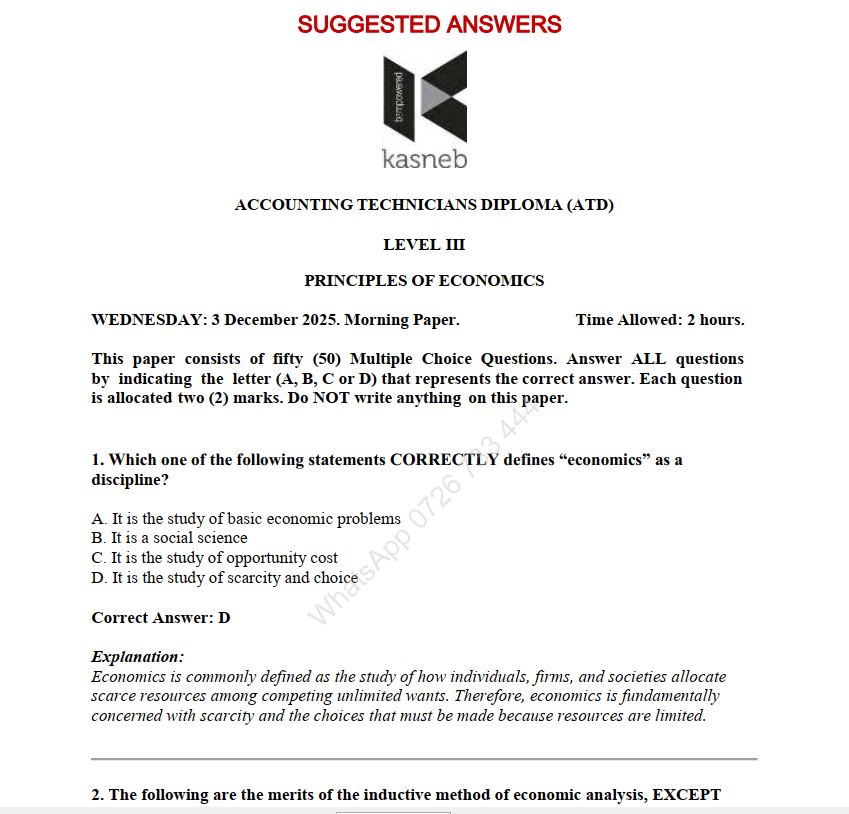
ACCOUNTING TECHNICIANS DIPLOMA (ATD) LEVEL III
PRINCIPLES OF ECONOMICS
WEDNESDAY: 3 December 2025. Morning Paper. Time Allowed: 2 hours.
This paper consists of fifty (50) Multiple Choice Questions. Answer ALL questions by indicating the letter (A, B, C or D) that represents the correct answer. Each question is allocated two (2) marks. Do NOT write anything on this paper.
1. Which one of the following statements CORRECTLY defines “economics” as a discipline?
A. It is the study of basic economic problems
B. It is a social science
C. It is the study of opportunity cost
D. It is the study of scarcity and choice (2 marks)
2. The following are the merits of the inductive method of economic analysis, EXCEPT .
A. it acts as a guide for future investigation
B. it is more realistic since it is based on facts
C. it is simple in nature
D. it is dynamic (2 marks)
3. Which one of the following items is NOT an adjustment to the output method of measuring national income?
A. Exports
B. Appreciation
C. Subsidies
D. Net factor income from abroad (2 marks)
4. The following are the characteristics of a planned economy, EXCEPT there is .
A. no freedom of choice
B. ownership of private property
C. equal distribution of income
D. control over negative externalities (2 marks)
5. Which one of the following factors does NOT determine the rate of interest in an economy?
A. Balance of payments
B. Demand for money
C. Government policy
D. Financial risk (2 marks)
6. The following are the assumptions of the law of supply, EXCEPT .
A. it assumes a short-run situation
B. it assumes perfect competition
C. it assumes consumers are rational
D. there is ceteris paribus (2 marks)
7. Which one of the following factors might lead to an up-ward shift in the demand curve?
A. Increase in taxation
B. Increase in consumer’s income
C. Increase in population
D. Future expectation of an increase in price (2 marks)
8. The following are the demerits of barriers of international trade, EXCEPT it .
A. encourages illegal trade
B. decreases government revenue
C. encourages monopoly
D. provides a variety of goods and services (2 marks)
9. Which one of the following is NOT an objective of trade unions in an economy?
A. Control discrimination against workers
B. Control corruption at places of work
C. Promote better housing for workers
D. Promote unity of workers (2 marks)
10. Which one of the following is an effect of a price floor?
A. It decreases government revenue
B. It promotes consumer exploitation
C. It creates a surplus produce
D. It encourages illegal trade (2 marks)
11. Which one of the following is NOT an assumption of the law of variable proportions?
A. Technology is constant
B. Producers are rational
C. Only one factor is variable
D. Assumes a short-run situation (2 marks)
12. Which one of the following is NOT a characteristic of a firm operating under oligopoly?
A. There is free entry and exit
B. The demand curve is kinked
C. There are normal profits in the long-run
D. There are many sellers (2 marks)
Use the following information to answer Question 13 and Question 14.
Oplex Enterprises Ltd. is involved in the production of commodity K. The firm has estimated that the fixed costs of producing commodity K is Sh.860,000. The variable cost per unit is Sh.12,000 and the selling price per unit of commodity K is Sh.15,000.
13. Determine the number of units of commodity K that the firm must produce in order to break-even.
A. 28.67
B. 186.3
C. 267.68
D. 286.67 (2 marks)
14. Suppose the fixed costs of Oplex Enterprises Ltd. increased to Sh.1million, while the variable costs per unit and the selling price per unit increased to Sh.15,000 and Sh.20,000 respectively. Determine the number of units that the firm must produce in order to break-even.
A. 20
B. 215
C. 200
D. 2,000 (2 marks)
15. Which one of the following factors does NOT limit the success of economic integration in developing countries?
A. Political instability
B. Poor infrastructure
C. Difference in currencies
D. Corruption (2 marks)
16. The following are the causes of cost-push inflation, EXCEPT .
A. high population
B. inflation
C. high taxes
D. high interest rates (2 marks)
17. Which one of the following outcomes is NOT a demerit of a monetary economy?
A. It causes equal distribution of wealth
B. It causes unequal distribution of income
C. It causes unequal social evils like crimes
D. It creates unfair competition
(2 marks)
18.
Which one of the following is NOT a demerit of localisation of industries?
A. It causes extensive pollution in the area
B. It reduces the depletion of local natural resources
C. It causes social evils like crimes
D. It causes rural-urban migration
(2 marks)
19. The following are the functions of non-banking financial institutions, EXCEPT .
A. giving advise
B. guaranteeing loans
C. creation of employment
D. printing of money (2 marks)
20. Which one of the following is NOT a measure of correcting regional economic development imbalances in developing countries?
A. Restricting trade networks between neighboring countries
B. Providing free education and training
C. Encouraging both domestic and foreign direct investment
D. Developing infrastructure in all regions (2 marks)
21. Which one of the following is an expansionary monetary policy?
A. Decrease in interest rate
B. Decrease in cash ratio
C. Increase in reserve requirements
D. Buying back of securities (2 marks)
22. The following are the demerits of adopting labour-intensive techniques of production, EXCEPT .
A. absenteeism of workers might be rampant
B. there is consistent quality of output
C. they require high level of skills
D. the cost of training labour might be high (2 marks)
23. Which one of the following is NOT an advantage of oligopoly?
A. There is creation of employment
B. The government earns revenue
C. There is greater freedom of choice
D. It provides essential goods and services (2 marks)
24. The following information relates to a hypothetical economy X in million shillings. The stock of money is Sh.60 million. Each Kenyan shilling exchanges hands on average 4 times per year. The number of transactions for the hypothetical economy X is 25 million per year. Determine the general price level for this economy.
A. Sh.5
B. Sh.9.6
C. Sh.6.2
D. Sh.4.5
(2 marks)
25.
Which one of the following is NOT an element of the fiscal policy?
A. Reserve requirement
B. National budget
C. Public borrowing
D. Public revenue
(2 marks)
26.
Which of the following types of goods fall under the exception of the law of demand?
A. Producer goods
B. Subsistence goods
C. Veblen goods
D. Consumer goods
(2 marks)
27. Which one of the following is NOT a condition necessary for price discrimination?
A. The markets must be separate
B. It should be easy to resell the product
C. There should only be one seller in the market
D. There is special orders sale (2 marks)
28. Which one of the following is a Keynesian motive for liquidity preference?
A. Store of value motive
B. Standard for deferred payment motive
C. Production motive
D. Speculative motive (2 marks)
29. Which one of the following is a component of monetary policy?
A. Bank rate
B. Public borrowing
C. Tax policy
D. Public expenditure (2 marks)
30. Which one of the following is NOT a disadvantage of overpopulation?
A. It leads to labour mobility
B. It causes high government expenditure
C. It causes high rate of unemployment
D. It increases social evils and crime (2 marks)
31. The marginal propensity to consume (MPS) of an economy is given as 0.85. Determine the marginal propensity to save (MPS).
A. 1.5
B. 2.5
C. 0.15
D. 0.25 (2 marks)
32. Which one of the following is a source of oligopoly?
A. Low capital
B. Lack of government control
C. Independent firms
D. Control of inputs (2 marks)
33. Which of the following is the primary cause of cyclical unemployment?
A. Technological advancements reducing labor demand
B. Seasonal changes affecting certain industries
C. Economic downturns leading to reduced demand for goods and services
D. Workers switching jobs voluntarily (2 marks)
34. The following are types of unemployment, EXCEPT .
A. Technological
B. Seasonal
C. Productive
D. Cyclical (2 marks)
35. Which one of the following is NOT an exception to the law of diminishing marginal utility?
A. Inferior goods
B. Knowledge
C. Sports
D. Alcohol (2 marks)
36. Which one of the following is NOT a role of co-operative societies?
A. Giving loans
B. Control credit
C. Marketing goods
D. Provide storage (2 marks)
37. Which one of the following is a benefit of proper economic planning?
A. Unfavourable balance of payment
B. Increase resource duplication
C. Reduce foreign aid
D. Reduce macro-economic problems
(2 marks)
38.
Which one of the following is a negative effect of high interest rates?
A. Reduced unemployment
B. High national income
C. Reduced investments
D. Increased government revenue
(2 marks)
39.
Which one of the following statements CORRECTLY describes the Phillip’s Curve?
A. It shows the relationship between economic growth and economic development
B. It shows the relationship between inflation and unemployment
C. It shows the relationship between multiplier and accelerator
D. It shows the relationship between monetary policy and fiscal policy
(2 marks)
40.
Which one of the following is NOT a method of clearing external public debts?
A. Debt restructuring
B. Debt reduction
C. Management of debt accumulation
D. Reducing tax base
(2 marks)
41.
Which one of the following is a characteristic of money?
A. Simple
B. Available
C. Expensive
D. Durable
(2 marks)
42.
Which one of the following is NOT a type of labour mobility?
A. Vertical
B. Diagonal
C. Horizontal
D. Occupational
(2 marks)
43.
Which one of the following is NOT a factor that determines the cost behaviour of a firm?
A. Technology
B. Firm’s size
C. Economic boom
D. Government policy
(2 marks)
44.
Which one of the following statements is a property of isoquants?
A. They are positively sloped
B. They are concave to the origin
C. They never intersect
D. They are not asymptotic
(2 marks)
45.
Which one of the following is NOT a measure to correct balance of payments deficit?
A. Economic integration
B. Imports substitution
C. Improve terms of trade
D. Exports reduction
(2 marks)
46.
Which one of the following is a problem facing the agricultural sector in developing countries?
A. Price fluctuations
B. Increased exports
C. Technology advancement
D. Infrastructure development
(2 marks)
47. Demand is said to be elastic when change in .
A. price is proportionately equal to change in demand
B. demand is more than proportionate to the change in price
C. price leads to infinite change in demand
D. demand is small compared to the change in price (2 marks)
48. Which one of the following is an objective of a minimum wage in a country?
A. To protect employers
B. To reduce government revenue
C. To reduce industrial disputes
D. To improve employer efficiency
(2 marks)
49.
Which one of the following statements defines external diseconomies of scale?
A. Disadvantages that limit the expansion of a firm
B. Advantages of large-scale production
C. Increased cost of production incurred by small firms
D. Advantages of small-scale production
(2 marks)
50.
Which one of the following is NOT a measure to control inflation?
A. Selective credit control
B. High marginal value requirement
C. Increased cash ratio
D. Increased public expenditure
(2 marks)
……………………………………………………………….
Related products
-

ATD 3 Principles of Economics Pdf Revision Kit
Original price was: KSh800.KSh699Current price is: KSh699. Download -
Principles of Economics August 2026 ATD Level III Answers
Original price was: KSh500.KSh399Current price is: KSh399. Download -
Principles of Economics April 2026 ATD Level III Answers
Original price was: KSh500.KSh399Current price is: KSh399. Download