Original price was: KSh500.KSh399Current price is: KSh399.
Download Principles of Economics April 2026 ATD Level III Answers
Description
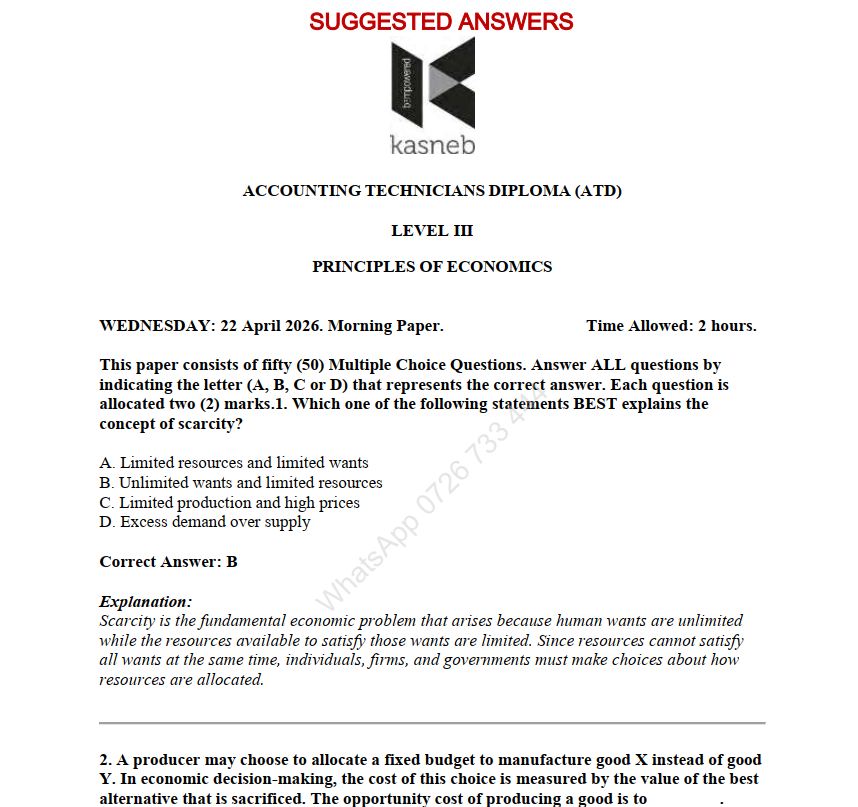
ACCOUNTING TECHNICIANS DIPLOMA (ATD) LEVEL III
PRINCIPLES OF ECONOMICS
WEDNESDAY: 22 April 2026. Morning Paper. Time Allowed: 2 hours.
This paper consists of fifty (50) Multiple Choice Questions. Answer ALL questions by indicating the letter (A, B, C or D) that represents the correct answer. Each question is allocated two (2) marks.
1. Which one of the following statements BEST explains the concept of scarcity?
A. Limited resources and limited wants
B. Unlimited wants and limited resources
C. Limited production and high prices
D. Excess demand over supply (2 marks)
2. A producer may choose to allocate a fixed budget to manufacture good X instead of good Y. In economic decision-making, the cost of this choice is measured by the value of the best alternative that is sacrificed. The opportunity cost of producing a good is to .
A. the monetary cost of production
B. the cost of raw materials used
C. the value of the next best alternative foregone
D. the cost of labour employed (2 marks)
3. Suppose an economy improves its capacity to produce both consumer and capital goods due to better technology and improved efficiency in resource utilisation. A rightward shift of the production possibility frontier indicates?
A. Misallocation of resources
B. Technological progress
C. Increase in unemployment
D. Decrease in population (2 marks)
4. Which of the following is NOT a characteristic of a free market economy?
A. Consumer sovereignty
B. Profit motive
C. Private ownership of resources
D. Government price fixing (2 marks)
5. In a competitive market, the responsiveness of quantity supplied to a change in price is a key concept in supply analysis. When price of a commodity rises from Sh.100 to Sh.120 and quantity supplied increases from 50 units to 70 units, supply is .
A. perfectly elastic
B. elastic
C. inelastic
D. unitary elastic (2 marks)
6. In supply analysis, a movement along the supply curve occurs when only the price of the commodity changes while other determinants remain constant (ceteris paribus). Identify a factor listed below that causes a movement along the supply curve.
A. Change in technology
B. Change in weather conditions
C. Change in taxation
D. Change in price of the commodity (2 marks)
7. Income elasticity measures how quantity demanded changes when consumer income changes. Which of the following goods has negative income elasticity of demand?
A. Luxury goods
B. Normal goods
C. Inferior goods
D. Complementary goods (2 marks)
8. In price control, governments may impose a maximum price to protect consumers. If a price ceiling is set above equilibrium price in a competitive market, what outcome is MOST likely?
A. have no effect
B. create surplus
C. create shortage
D. increase equilibrium price (2 marks)
9. Which of the following statement describes the cardinal utility theory?
A. Utility is ranked
B. Utility is measurable in numbers
C. Preferences are unstable
D. Indifference curves are convex (2 marks)
10. Which of the following BEST describes the national income of a country?
A. The total value of imports and exports within a year
B. The total government revenue collected from taxes in a year
C. The total value of goods produced by private firms only
D. The total monetary value of final goods and services produced by the residents of a country within a given period (2 marks)
11. Assume a firm’s total cost function combines fixed cost and variable cost such that TC = 200 + 5Q, where Q is output. If the total cost changes with output at a constant rate, what is the marginal cost?
A. 200
B. 5
C. 5Q
D. 205 (2 marks)
12. A firm chooses its output level by comparing the additional revenue from selling one more unit with the additional cost of producing it. Which one of the equations below indicates the level of profit maximisation.
A. Total Revenue = Total Cost
B. Marginal Revenue = Marginal Cost
C. Average Cost = Average Revenue
D. Marginal Cost = Average cost (2 marks)
13. Which one of the following market structures has differentiated products and free entry?
A. Monopoly
B. Oligopoly
C. Monopolistic competition
D. Perfect competition (2 marks)
14. In markets dominated by a few large firms, each firm’s pricing decision may depend on rivals’ likely reactions, leading to price rigidity. The kinked demand curve is associated with which market?
A. Oligopoly
B. Monopoly
C. Perfect competition
D. Duopoly only (2 marks)
15. In production theory, the long run is the period in which a firm can adjust all inputs and scale of operation. In the long run, all costs are .
A. fixed
B. marginal
C. sunk
D. variable (2 marks)
16. Money performs several functions in an economy, including facilitating trade and acting as a unit of account. Which one of the following is NOT a function of money?
A. Medium of exchange
B. Store of value
C. Unit of account
D. Measure of welfare (2 marks)
17. Central banks use interest rates to influence borrowing, spending and inflation. An increase in bank rate is likely to result in .
A. increase in money supply
B. reduced inflationary pressure
C. increased borrowing
D. increase in investment (2 marks)
18. During a recession, a government may adopt policies aimed at boosting aggregate demand and output. Expansionary fiscal policy involves .
A. reducing government expenditure
B. increasing taxation
C. increasing government expenditure (2 marks)
D. selling government securities
19. Cost-push inflation is caused by .
A. excess demand
B. increase in production costs
C. high exports
D. budget surplus (2 marks)
20. The Phillips Curve shows the relationship between .
A. inflation and unemployment
B. interest rate and inflation
C. unemployment and Gross Domestic Product
D. money supply and inflation (2 marks)
21. National income accounting distinguishes between gross and net measures by accounting for capital consumption (depreciation). Gross Domestic Product (GDP) at market prices minus depreciation equals .
A. NNP
B. GNP
C. NNI
D. disposable income (2 marks)
22. Which of the following is a leakage in the circular flow of income?
A. Investment
B. Exports
C. Imports
D. Government spending (2 marks)
23. In the Keynesian model, the multiplier measures how an initial change in spending leads to a larger total change in national income. If Marginal Propensity to Save (MPC) = 0.8, the multiplier is equal to .
A. 4
B. 5
C. 0.2
D. 1.25 (2 marks)
24. When planned aggregate expenditure is insufficient to purchase the full-employment level of output, the economy experiences a gap. A deflationary gap occurs when .
A. AS exceeds AD at full employment
B. aggregate demand exceeds aggregate supply
C. inflation rises
D. taxes increase (2 marks)
25. Comparative advantage is based on which of the following?
A. absolute cost
B. opportunity cost
C. labour cost
D. monetary value (2 marks)
26. In the context of imports, a quota refers to .
A. tax on imports
B. subsidy
C. quantitative restriction on imports
D. ban on exports (2 marks)
27. Which international organisation is primarily responsible for establishing and enforcing rules that govern global trade among countries?
A. International Monetary Fund (IMF)
B. World Bank
C. World Trade Organisation (WTO)
D. United Nations Development Programme (UNDP) (2 marks)
28. In economic development, human capital refers to .
A. machines and tools
B. skills and knowledge of labour
C. financial assets
D. natural resources (2 marks)
29. Structural unemployment arises due to .
A. seasonal changes
B. economic downturn
C. skills mismatch
D. voluntary job change (2 marks)
30. Disguised unemployment is common in which of the following sectors of the economy?
A. Agriculture
B. Mining
C. Manufacturing
D. Banking (2 marks)
31. According to the Quantity Theory of Money, represented by the equation MV = PT, which of the following statements is correct?
A. The total supply of goods in an economy is always equal to the velocity of money
B. The amount of money in circulation determines only the level of employment
C. The value of transactions depends only on the quantity of goods produced
D. The total amount of money spent in the economy equals the total value of goods and services transacted
(2 marks)
32. Which of the following statements is NOT an objective of economic development?
A. Full employment
B. Income redistribution
C. Price instability
D. Poverty reduction (2 marks)
33. An increase in minimum wage may lead to .
A. decrease in unemployment
B. excess supply of labour
C. price ceiling
D. increased exports (2 marks)
34. As firms expand output in the long run, they may enjoy lower average costs due to specialisation and bulk purchasing. Economies of scale result in .
A. rising average costs
B. constant costs
C. falling average costs
D. marginal costs exceeding average cost (2 marks)
35. Which one of the following statements is an example of external diseconomies of scale?
A. Managerial inefficiency
B. Congestion in the industry
C. Poor supervision
D. Internal disputes (2 marks)
36. Monetary authorities influence macroeconomic variables by adjusting liquidity and credit conditions in the economy. Monetary policy primarily targets .
A. taxation
B. government borrowing
C. money supply
D. public expenditure (2 marks)
37. Which of the following statements is NOT a feature of monopoly?
A. Single seller
B. Barriers to entry
C. Supernormal profit possible
D. Price taker (2 marks)
38. When consumer income rises, the demand for some goods increases. Such goods are described as normal goods. A normal good has elasticity.
A. negative income
B. zero
C. positive income
D. infinite (2 marks)
39. Which stage of diminishing returns shows increasing marginal product?
A. Stage I
B. Stage II
C. Stage III
D. Stage IV (2 marks)
40. Exchange rate movements affect trade and domestic prices. An appreciation of currency leads to
.
A. cheaper exports
B. more expensive imports
C. cheaper imports
D. trade surplus automatically (2 marks)
41. What does the reserve ratio primarily influence in the banking system?
A. Government expenditure
B. Bank lending capacity
C. Inflation rate directly
D. Tax revenue (2 marks)
42. Which of the following is most likely to occur when a country imposes a tariff on imported goods?
A. Domestic consumers pay lower prices for imported goods
B. The quantity of imports into the country increases
C. Domestic producers face greater competition from foreign firms
D. The government earns revenue from taxes charged on imported goods (2 marks)
43. For a monopolist to charge different prices to different consumers for the same product, certain conditions must hold, including separation of markets. Price discrimination requires .
A. free resale
B. homogeneous markets
C. market separation
D. many sellers (2 marks)
44. Which one of the following statements is a merit of protectionism?
A. Encourages dumping
B. Protects infant industries
C. Promotes imports
D. Increases foreign competition (2 marks)
45. In marginal decision-making, a firm compares the extra revenue from selling an additional unit with the extra cost of producing it. If marginal revenue is greater than Marginal cost the firm should .
A. reduce output
B. shut down
C. maintain output
D. increase output (2 marks)
46. The accelerator principle relates investment to .
A. interest rate
B. income changes
C. government spending
D. taxation (2 marks)
47. Which of the following terms is NOT a non-tariff barrier?
A. Quota
B. Technical standards
C. Customs duty
D. Embargo (2 marks)
48. Oligopoly firms are characterised by .
A. independence
B. interdependence
C. perfect knowledge
D. price taking (2 marks)
49. In simple macroeconomic identities, national income is allocated between consumption and saving. The Marginal Propensity to Save (MPS) plus Marginal Propensity to Consume (MPC) equals .
A. 0
B. 0.5
C. 1
D. 2 (2 marks)
50. A firm has a total cost (TC) function given by: TC=50+4Q, where Q is the quantity of output produced. What is the marginal cost (MC) of producing one additional unit of output?
A. 50
B. 54
C. 4Q4Q4Q
D. 4 (2 marks)
…………………………………………………………………………….
Related products
-

Principles of Economics August 2026 ATD Level III Answers
Original price was: KSh500.KSh399Current price is: KSh399. Download -

ATD 3 Principles of Economics Pdf Revision Kit
Original price was: KSh800.KSh699Current price is: KSh699. Download -
Principles of Economics December 2025 ATD Level III Answers
Original price was: KSh500.KSh399Current price is: KSh399. Download