Original price was: KSh600.KSh399Current price is: KSh399.
Download December 2025 Strategic Management Past Paper answers in Pdf form
Description
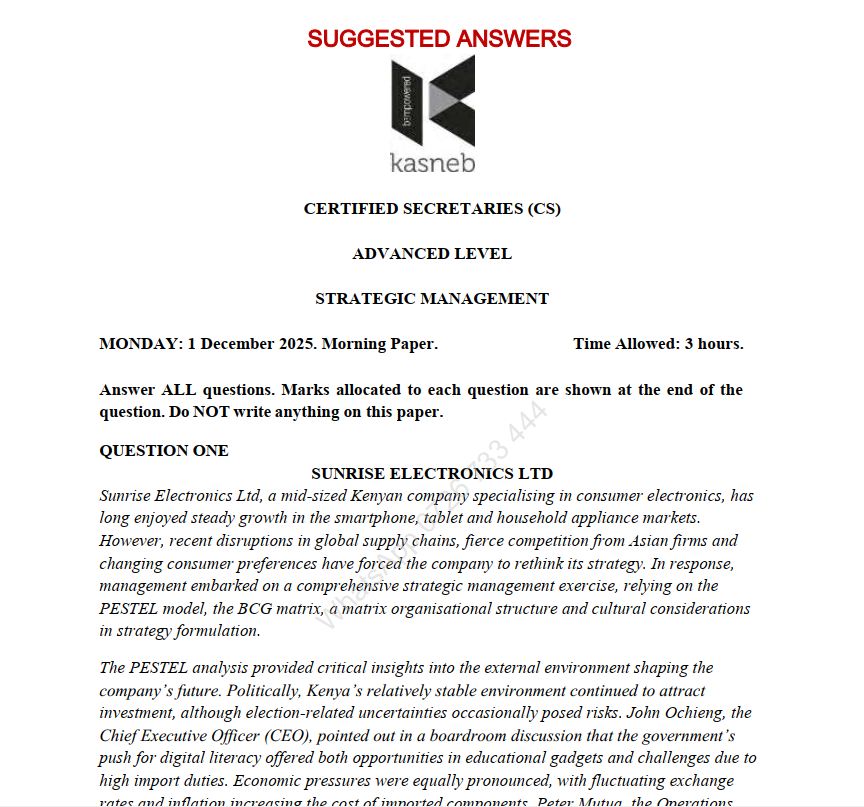
CERTIFIED SECRETARIES (CS) ADVANCED LEVEL STRATEGIC MANAGEMENT
MONDAY: 1 December 2025. Morning Paper. Time Allowed: 3 hours.
This paper consists of five (5) questions. Question one is a case study. Answer ALL questions. Marks allocated to each question are shown at the end of the question. Do NOT write anything on this paper.
QUESTION ONE
SUNRISE ELECTRONICS LTD.
Sunrise Electronics Ltd, a mid-sized Kenyan company specialising in consumer electronics, has long enjoyed steady growth in the smartphone, tablet and household appliance markets. However, recent disruptions in global supply chains, fierce competition from Asian firms and changing consumer preferences have forced the company to rethink its strategy. In response, management embarked on a comprehensive strategic management exercise, relying on the PESTEL model, the BCG matrix, a matrix organisational structure and cultural considerations in strategy formulation.
The PESTEL analysis provided critical insights into the external environment shaping the company’s future. Politically, Kenya’s relatively stable environment continued to attract investment, although election-related uncertainties occasionally posed risks. John Ochieng, the Chief Executive Officer (CEO), pointed out in a boardroom discussion that the government’s push for digital literacy offered both opportunities in educational gadgets and challenges due to high import duties. Economic pressures were equally pronounced, with fluctuating exchange rates and inflation increasing the cost of imported components. Peter Mutua, the Operations Manager, remarked that rising shipping costs were eroding profit margins and that local sourcing had to be considered more seriously. On the social front, younger consumers increasingly demanded trendy yet affordable smartphones, while middle-class families sought energy-efficient appliances. Aisha Tum, Head of Marketing, explained to her team that the cultural emphasis on status made consumers prefer premium-looking devices, even when affordability remained a major factor. Technological forces added further complexity, as rapid advances in 5G connectivity and smart home integration created opportunities while heightening pressure to innovate. Ecological awareness was another driver, pushing Sunrise Electronics Ltd. to adopt eco-friendly packaging and energy-efficient products. Lucy Mandera, the Human Resource (HR) Director, emphasised in a staff forum that employees themselves were becoming more concerned about sustainability and wanted the company’s practices to reflect this commitment. Finally, the legal environment demanded compliance with labour laws, intellectual property rights and consumer protection regulations. Jointly, these factors outlined both opportunities and threats the company had to navigate.
Alongside the environmental scanning the leadership turned to BCG matrix to review its product portfolio. Smartphones, with a high market share in a fast-growing sector, emerged as the company’s star product, demanding heavy investment in research, development and marketing. Home appliances, with steady sales and reliable profits, were classified as cash cows, providing the financial backbone to fund innovation. Tablets, though facing declining global demand, were placed as question mark, with potential for niche use in the educational sector. DVD players, however, were deemed dogs, with falling sales and little prospect of revival, prompting discussions of phasing them out. During a strategy session, John Ochieng stressed that smartphones would be the future growth engine, but cash cows like appliances had to be maintained to fund ongoing initiatives. To implement these strategic decisions, the company relied on a matrix organisational structure, where employees reported both to functional heads such as marketing, operations and HR and to product managers overseeing categories like smartphones and appliances. This structure encouraged collaboration across functions and allowed the company to respond quickly to market shifts while leveraging specialised expertise. However, it also created challenges, in that employees sometimes complained of confusion caused by dual reporting, while conflicts over resource allocation between departments were frequent. Lucy Mandera later admitted that staff often felt pulled in two directions, with the marketing team pushing for faster product launches while operations department insisted on maintaining strict quality and cost controls. To mitigate these conflicts, HR introduced training on collaboration and conflict resolution, while the leadership appointed project coordinators to smooth communication.
Beyond structures and systems, culture played a decisive role in shaping strategy at Sunrise Electronics Ltd. The company had long prided itself on fostering a culture of innovation, teamwork and customer focus. Innovation was encouraged by dedicating funds to employee-driven projects, giving staff the chance to see their creative ideas materialise. Aisha noted that marketing employees were more engaged when their campaigns were actually implemented.
Teamwork was vital under the matrix structure and was reinforced through regular team-building exercises. Customer focus was embedded in training programs that emphasised putting consumer needs at the center of decisions, from product design to after-sales service. Despite these cultural strengths, tensions sometimes arose. Peter pointed out that the operations department occasionally resisted the emphasis on innovation because it clashed with the traditional culture of efficiency and cost-cutting. This highlighted the importance of aligning cultural values with strategic imperatives. The culmination of these analyses led to a set of strategic decisions. The company committed to heavy investment in smartphones, focusing on mid-range devices with premium designs tailored to Africa’s youthful market. Home appliances would continue to be upgraded, with particular emphasis on energy efficiency to meet both consumer demand and environmental expectations. Tablets would be retained as experimental products, with efforts to partner with the government in educational programs. DVD players, on the other hand, would be phased out gradually, with resources redirected to more promising ventures. The matrix structure would be maintained but fine-tuned to reduce role conflicts. HR launched initiatives to strengthen adaptability and a shared sense of ownership among employees.
The perspectives of the four key staff members revealed the different dimensions of the company’s strategic journey. The CEO, stressed vision and alignment, telling staff that the future depended not on predicting outcomes but on preparing for multiple possibilities. Aisha focused on consumer trends, advocating for aggressive digital campaigns to capture the youth segment. Peter Mutua emphasised efficiency, particularly the need to source locally to protect margins. Lucy Mandera, meanwhile, championed a people-centered approach, embedding cultural values into training and performance management systems. The company’s ability to balance growth with stability, innovation with efficiency and individual accountability with teamwork determined its resilience in a competitive marketplace. aligning people, processes and products, Sunrise Electronics Ltd sought not only to secure its future but also to build an organisational culture that could sustain strategy through turbulent times.
Required:
(a) Using relevant examples, explain FIVE ways in which PESTEL analysis enabled Sunrise Electronics Ltd. to identify opportunities and threats within its external business environment. (10 marks)
(b) Examine FIVE strategic recommendations you would make for the “Question Mark” product at Sunrise Electronics Ltd., considering both market trends and organisational priorities. (10 marks)
(c) Using examples from staff experiences reported at Sunrise Electronics Ltd., assess FIVE advantages of the matrix organisational structure adopted by Sunrise Electronics Ltd. (10 marks)
(d) Explain FIVE instances in which organisation culture supported implementation of Sunrise Electronics’ strategic initiatives. (10 marks)
(Total: 40 marks)
QUESTION TWO
(a) Highlight FOUR limitations of outsourcing when designing an organisation structure for strategy implementation. (4 marks)
(b) Analyse FIVE sources of competitor information during competitor analysis. (5 marks)
(c) Bidii Limited has adopted a hybrid strategy for its 2025-2030 corporate strategic plan.
Describe THREE challenges associated with this strategy. (6 marks)
(Total: 15 marks)
QUESTION THREE
(a) As part of its internationalisation strategy, ABC limited has adopted location advantage approach.
Explain FOUR roles that location advantage plays in supporting this strategy. (4 marks)
(b) Explain FIVE traits commonly associated with the Trait Theory of Leadership. (5 marks)
(c) Examine THREE components of the paradox of logic and creativity. (6 marks)
(Total: 15 marks)
QUESTION FOUR
(a) Appraise FOUR components of the VRIO-framework. (4 marks)
(b) Outline FIVE observable patterns that illustrate how organisations formulate, implement and adapt their strategies in practice. (5 marks)
(c) Haraka Traders is experiencing a strategic drift in its newly launched strategic plan.
Examine THREE ways of correcting this drift. (6 marks)
(Total: 15 marks)
QUESTION FIVE
(a) Explain FOUR roles of vision statements in an organisation. (4 marks)
(b) Strategic control is the process of monitoring and evaluating the implementation of strategic plans.
In view of this statement, analyse FIVE steps in this process. (5 marks)
(c) When a company faces declining performance or financial pressure, it may adopt a retrenchment strategy. Describe SIX features that characterise this type of strategy. (6 marks)
(Total: 15 marks)
…………………………………………………………………………………………………….
Related products
-
December 2024 Meetings, Compliance and Administration Past Paper Answers
Original price was: KSh600.KSh299Current price is: KSh299. Download -
December 2024 Human Resource Management Past Paper Answers
Original price was: KSh500.KSh299Current price is: KSh299. Download -
- Collection of Strategic Management Pdf Past Papers Answers (December 2021 to APRIL 2026)
Original price was: KSh1,200.KSh899Current price is: KSh899. Download -
- Collection of CPA CS Information Communication Technology (ICT) Pdf Past Paper Answers (September 2015 to DECEMBER 2025)
Original price was: KSh899.KSh699Current price is: KSh699. Download