Original price was: KSh600.KSh499Current price is: KSh499.
Download April 2026 Strategic Management Past Paper answers in Pdf form
Description
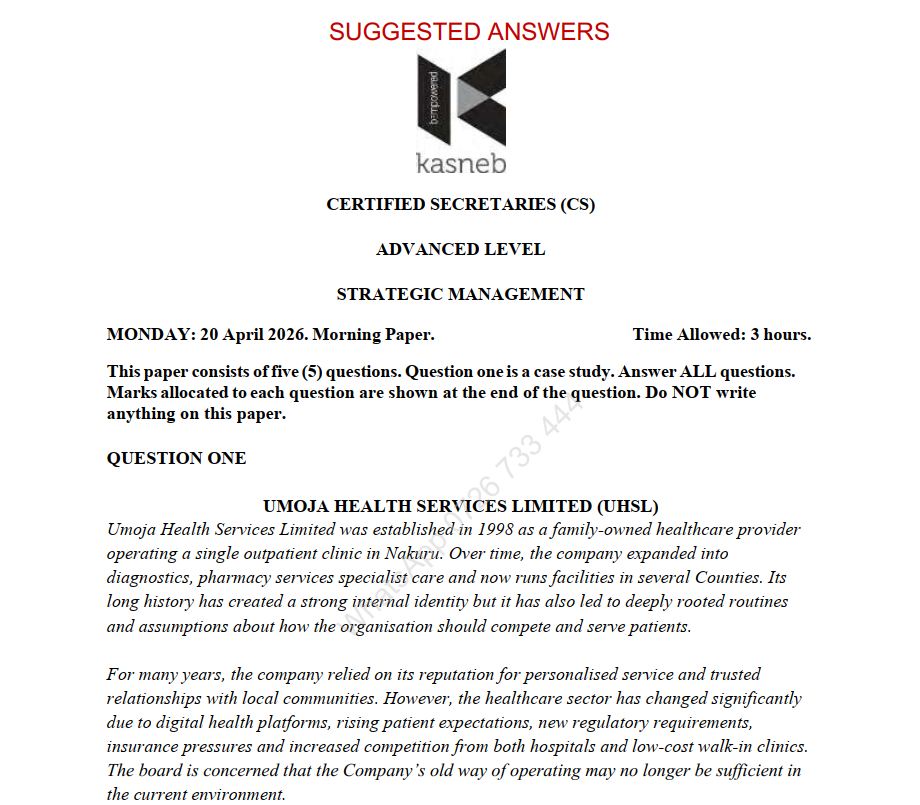
CERTIFIED SECRETARIES (CS) ADVANCED LEVEL STRATEGIC MANAGEMENT
MONDAY: 20 April 2026. Morning Paper. Time Allowed: 3 hours.
This paper consists of five (5) questions. Question one is a case study. Answer ALL questions. Marks allocated to each question are shown at the end of the question. Do NOT write anything on this paper.
QUESTION ONE
UMOJA HEALTH SERVICES LIMITED (UHSL)
Umoja Health Services Limited was established in 1998 as a family-owned healthcare provider operating a single outpatient clinic in Nakuru. Over time, the company expanded into diagnostics, pharmacy services specialist care and now runs facilities in several Counties. Its long history has created a strong internal identity but it has also led to deeply rooted routines and assumptions about how the organisation should compete and serve patients.
For many years, the company relied on its reputation for personalised service and trusted relationships with local communities. However, the healthcare sector has changed significantly due to digital health platforms, rising patient expectations, new regulatory requirements, insurance pressures and increased competition from both hospitals and low-cost walk-in clinics. The board is concerned that the Company’s old way of operating may no longer be sufficient in the current environment.
At a recent board retreat, disagreement emerged over the Company’s strategic direction. Some directors argued that the Company’s mission had remained too general and was being interpreted differently across departments. Others noted that while the Company’s publicly promoted patient-centred care, some internal practices seemed more focused on short-term revenue targets than quality outcomes. The board therefore resolved to review the Company’s mission, strategic objectives and values.
The Management also realised that the Company had not systematically assessed whether its internal resources and capabilities were still a source of competitive advantage. Some executives believed that the Company’s long-standing relationships with communities, strong clinical reputation and integrated service model remained valuable strengths. Others argued that these advantages would erode unless they were supported by technology, better process coordination and stronger performance monitoring.
To address these concerns, the board proposed a strategic review process that would include scenario planning, a review of the Company’s value-creating activities and a redesign of the performance measurement system. It was also suggested that the Company should establish stronger strategic surveillance and use better information systems to support long-term strategic control.
Required:
(a) Explain how the history of Umoja Health Services Limited could influence its present strategy using the concepts of path dependency and history as a resource. (8 marks)
(b) Drawing from the above case:
(i) Explain FOUR reasons why Umoja Health Services Limited should ensure that its strategic objectives are consistent with its mission (4 marks)
(ii) Using the information in the case, analyse FOUR internal weaknesses or strategic gaps that may undermine Umoja Health Services Limited’s competitiveness. (4 marks)
(c) Explain FOUR ways on how scenario planning and gap analysis could help the UHSL respond to uncertainty and avoid strategic drift. (8 marks)
(d) Discuss FOUR ways on how the use of VRIO analysis and the value chain/value system could help UHSL company identify and sustain competitive advantage. (8 marks)
(i) Explain how the Balanced Scorecard and Strategy Map could help UHSL align departmental priorities and improve performance monitoring. (4 marks)
(ii) Discuss how Strategic Information Systems and Strategic Surveillance could strengthen UHSL’s strategic control and long-term effectiveness. (4 marks) (Total: 40 marks)
QUESTION TWO
(a) Explain THREE benefits of analysing the political, economic, sociocultural, technological, ecological and legal (PESTEL) environment in strategic management. (6 marks)
(b) Describe TWO roles of industry analysis that could assist an organisation to identify opportunities, threats and its competitive position when formulating strategy. (4 marks)
(c) Summarise FIVE effects of industry life cycle analysis on strategic choice. (5 marks)
(Total: 15 marks)
QUESTION THREE
(a) Explain Bowman’s Strategy Clock model and illustrate how it can be used to evaluate an organisation’s strategic positioning. (4 marks)
(b) Analyse the role of each of the following strategies in shaping competitive behaviour.
(i) Cooperative strategy. (2 marks)
(ii) Game theory. (2 marks)
(c) Describe SEVEN features of an effective business model. (7 marks)
(Total: 15 marks)
QUESTION FOUR
(a) Propose FOUR strategic reasons why an organisation might adopt vertical integration. (8 marks)
(b) Describe SEVEN ways in which portfolio matrices could support strategic decision making in an organisation. (7 marks)
(Total: 15 marks)
QUESTION FIVE
(a) Assess FOUR applications of the McKinsey 7-S framework for diagnosing strategic alignment problems in an organisation. (8 marks)
(b) Evaluate SEVEN contributions of strategy communication to the success of strategy implementation in an organisation. (7 marks)
(Total: 15 marks)
…………………………………………………………………….
Related products
-

- Collection of Financial Markets and Specialised Institutions Pdf Past Paper Answers (December 2021 to APRIL 2026)
Original price was: KSh1,200.KSh899Current price is: KSh899. Download -
- Collection of CPA CS Company Law Pdf Past Paper Answers Topically and Yearly Arranged(September 2015 to AUGUST 2026)
Original price was: KSh1,200.KSh799Current price is: KSh799. Download -
- Collection of Meetings Compliance and Administration Pdf Past Paper Answers (December 2021 to APRIL 2026)
Original price was: KSh1,200.KSh899Current price is: KSh899. Download -

- Collection of Principles of Accounting and Taxation Pdf Past papers Answers (December 2021 to December 2024)
Download