Original price was: KSh600.KSh499Current price is: KSh499.
Download April 2026 Boardroom Dynamics Past Paper answers in Pdf form
Description
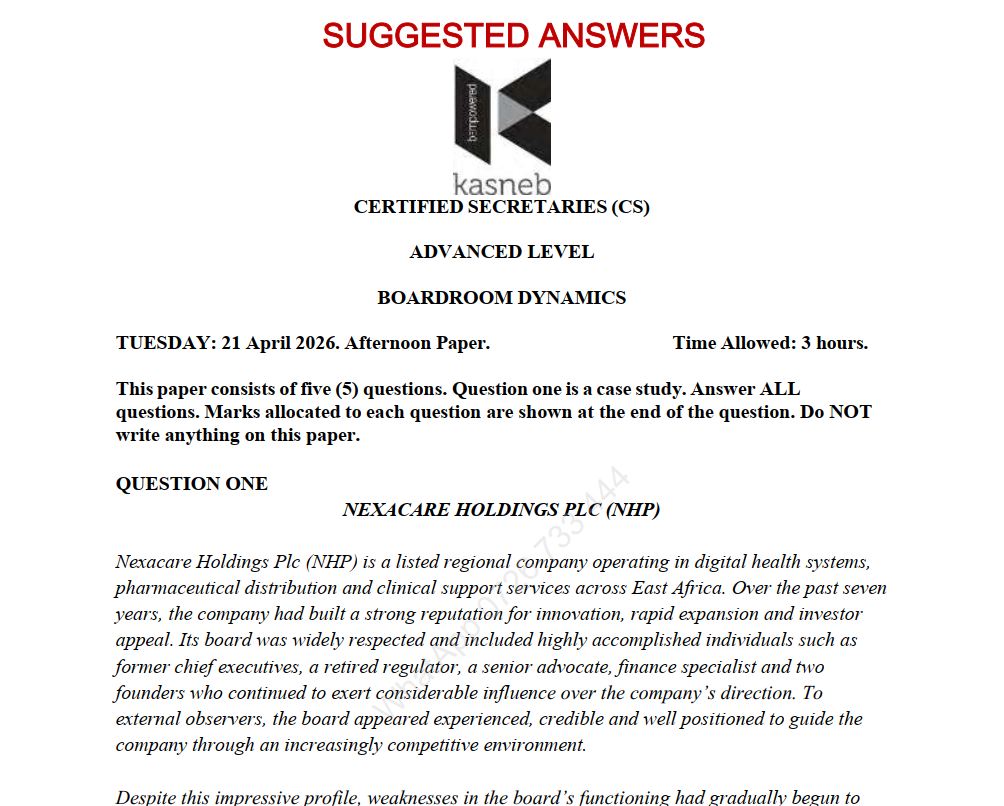
CERTIFIED SECRETARIES (CS) ADVANCED LEVEL BOARDROOM DYNAMICS
TUESDAY: 21 April 2026. Afternoon Paper. Time Allowed: 3 hours.
This paper consists of five (5) questions. Question one is a case study. Answer ALL questions. Marks allocated to each question are shown at the end of the question. Do NOT write anything on this paper.
QUESTION ONE
NEXACARE HOLDINGS PLC (NHP)
Nexacare Holdings Plc (NHP) is a listed regional company operating in digital health systems, pharmaceutical distribution and clinical support services across East Africa. Over the past seven years, the company had built a strong reputation for innovation, rapid expansion and investor appeal. Its board was widely respected and included highly accomplished individuals such as former chief executives, a retired regulator, a senior advocate, finance specialist and two founders who continued to exert considerable influence over the company’s direction. To external observers, the board appeared experienced, credible and well positioned to guide the company through an increasingly competitive environment.
Despite this impressive profile, weaknesses in the board’s functioning had gradually begun to emerge as the company expanded. Over time, the board had grown to fourteen members, partly to accommodate investor nominees, founding interests and sector specialists. What was once seen as a strength had increasingly become difficult to manage. Board discussions were often prolonged, some directors contributed very little and decision-making was frequently slowed by the need to accommodate many voices. Important matters were regularly referred to committees, but overlapping committee mandates had led to duplication of work, delays and uncertainty over accountability. A few directors had privately begun to question whether the board’s size and committee structure still suited the company’s strategic needs.
These structural concerns were reinforced by weaknesses in the board’s human capital profile. Although the board included many accomplished individuals, several directors shared similar professional backgrounds and tended to approach issues from comparable perspectives. At the same time, the company’s increasing dependence on technology, people capability and cross-border integration had exposed gaps in expertise in those areas. Directors with strong backgrounds in digital transformation, people strategy and regional integration were limited. The nomination committee had traditionally placed greater emphasis on reputation and seniority than on a systematic assessment of board capability gaps. As a result, the board possessed stature and experience, but not the breadth of competencies required for the company’s next stage of growth.
As pressure on the business increased, strains in the board’s internal dynamics also became more evident. A pattern was developed in which a few confident directors consistently set the tone of discussion, while others remained reserved during formal meetings and only shared their true views afterwards in smaller informal conversations. Although board meetings appeared orderly on the surface, much of the real debate tookplace outside the boardroom. Newer directors in particular, struggled to judge when to challenge prevailing assumptions and when to remain silent. Over time, this weakened trust, reduced openness and limited the board’s ability to function as a cohesive and effective team.
Alongside these dynamics, subtle cultural assumptions had begun to shape board behaviour in ways that were rarely acknowledged openly. The board often described itself as professional, objective and high performing. In practice, however, it tended to reward confidence, speed and certainty more than reflection, questioning and learning. Requests for additional evidence were sometimes interpreted as signs of weak commercial instinct while directors who raised implementation risks were labelled as overly cautious. These unwritten norms had influence on how issues were framed, whose views carried weight and what was regarded as a valuable contribution in the boardroom.
These weaknesses became especially visible when NHP considered acquiring Medilink Analytics, a fast-growing health data company in a neighbouring country. Management strongly supported the transaction and presented ambitious forecasts relating to market access, digital expansion and shareholder value. Because the opportunity appeared strategically attractive, the board moved quickly to evaluate the proposal. In doing so, several directors relied heavily on management summaries, while limited attention was given to independent evidence or alternative scenarios. As discussions progressed, it became apparent that some directors had been influenced by the company’s recent success in earlier expansion projects and had assumed that similar results will follow in this case.
The acquisition of Medilink Analytics was approved within eight months however, significant difficulties emerged thereafter. Integration costs proved much higher than expected, key staff from the acquired company left earlier than planned and the promised technology synergies failed to materialise within the projected period. Internal reviews later suggested that the board did not challenge underlying assumptions with sufficient rigour and failed to test whether optimism, overconfidence and selective use of information had affected its judgement during the approval process.
In response, the board commissioned an internal reflection exercise to understand what went wrong. The review concluded that the difficulties did not arise from a single poor decision, but rather from a combination of structural weaknesses, capability gaps, unspoken cultural norms and flawed judgement patterns. It also revealed that the board had paid insufficient attention to director succession and renewal, even though several long-serving members were approaching the point at which their energy, relevance and independence of thought had relatively declined.
As NHP prepared for a governance retreat, directors agreed that some form of renewal was necessary. Proposals under consideration included resizing the board, redefining committee mandates, introducing a more deliberate board capability matrix, strengthening succession planning, redesigning meeting flow and improving the way evidence was tested before major decisions were made. Some directors supported these reforms immediately. Others remained unconvinced and argued that the company’s difficulties are temporary and did not justify major changes to the board’s governance arrangements.
NHP therefore stood at a critical point. Its future was dependent not only on successful strategy execution, but also on whether its board ccould strengthen its structure, improve its human capital, confront hidden cultural assumptions and exercise better judgement in the face of uncertainty.
Required:
(a) Explain FOUR structural weaknesses in the governance structure of Nexacare Holdings Plc (NHP). (8 marks)
(b) Using evidence from the case, assess FOUR behavioral biases that may have shaped the board’s consideration of the acquisition of Medilink Analytics. (8 marks)
(c) (i) Outline FOUR human capital skills and competency gaps evident in the board of NHP. (4 marks)
(ii) Examine TWO ways in which those gaps affected the quality of board oversight. (4 marks)
(d) Analyse FOUR features of board team dynamics demonstrated in the case. (8 marks)
(e) (i) Describe FOUR cultural assumptions that could be inferred from this case. (4 marks)
(ii) Assess TWO measures that the board of NHP could adopt to improve its boardroom culture. (4 marks)
(Total: 40 marks)
QUESTION TWO
(a) Explain TWO drivers of boardroom dynamics as a distinct area in corporate governance. (4 marks)
(b) Describe FIVE historical shifts in the evolution of corporate governance codes. (5 marks)
(c) Analyse THREE governance implications of a board’s progression from the ceremonial phase to the progressive phase of board evolution. (6 marks)
(Total: 15 marks)
QUESTION THREE
(a) Explain TWO psychological theories that help in understanding boardroom dynamics. (4 marks)
(b) Analyse THREE forms of cognitive diversity that may improve quality of board deliberations. (6 marks)
(c) Assess FIVE consequences of poor agenda sequencing on boardroom dynamics. (5 marks)
(Total: 15 marks)
QUESTION FOUR
(a) Explain FOUR board-level actions that may strengthen recruitment and induction of board members. (4 marks)
(b) Analyse FIVE indicators that demonstrate that a board renewal process improves the relevance, independence and effectiveness of the board. (5 marks)
(c) Evaluate THREE ways in which contemporary governance developments are reshaping expectations of boards. (6 marks)
(Total: 15 marks)
QUESTION FIVE
(a) Distinguish between “a unitary board” and “a two-tier board”. (4 marks)
(b) Explain FIVE factors that should be considered in determining an appropriate board size and committee structure. (5 marks)
(c) Evaluate THREE structured techniques that may be used by a board to improve the quality of judgement in decision making. (6 marks)
(Total: 15 marks)
……………………………………………………………………….
Related products
-

- Collection of Strategic Management Pdf Past Papers Answers (December 2021 to APRIL 2026)
Original price was: KSh1,200.KSh899Current price is: KSh899. Download -

- Collection of Financial Markets and Specialised Institutions Pdf Past Paper Answers (December 2021 to APRIL 2026)
Original price was: KSh1,200.KSh899Current price is: KSh899. Download -

- Collection of CPA CS Information Communication Technology (ICT) Pdf Past Paper Answers (September 2015 to DECEMBER 2025)
Original price was: KSh899.KSh699Current price is: KSh699. Download -
August 2024 ICT CPA CS Past Paper answers
Original price was: KSh300.KSh199Current price is: KSh199. Download