Original price was: KSh600.KSh399Current price is: KSh399.
Download December 2025 Governance and Compliance Audit Past Paper answers in Pdf form
Description
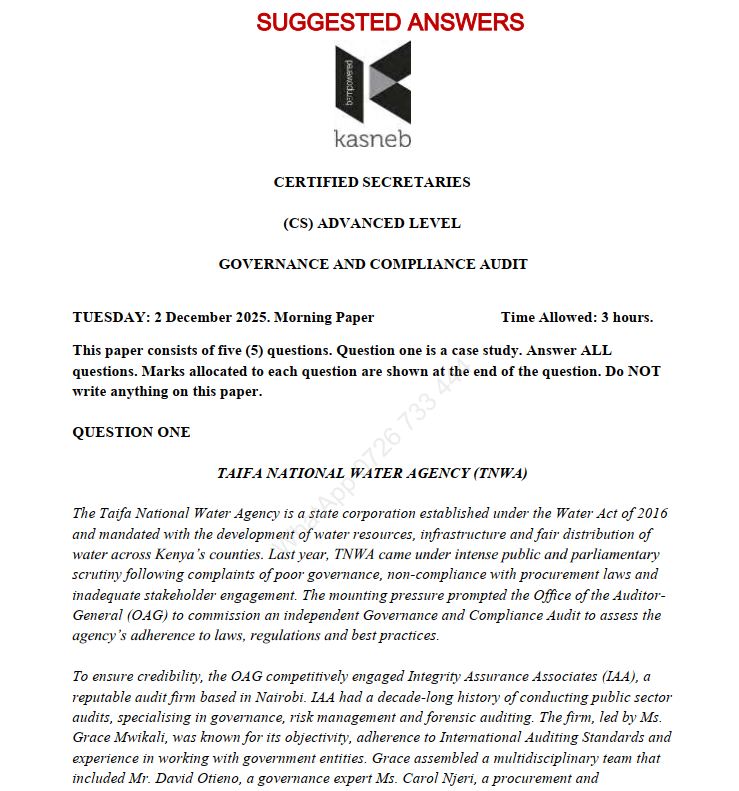
CERTIFIED SECRETARIES (CS) ADVANCED LEVEL
GOVERNANCE AND COMPLIANCE AUDIT
TUESDAY: 2 December 2025. Morning Paper. Time Allowed: 3 hours.
This paper consists of five (5) questions. Question one is a case study. Answer ALL questions. Marks allocated to each question are shown at the end of the question. Do NOT write anything on this paper.
QUESTION ONE
TAIFA NATIONAL WATER AGENCY (TNWA)
The Taifa National Water Agency is a state corporation established under the Water Act of 2016 and mandated with the development of water resources, infrastructure and fair distribution of water across Kenya’s counties. Last year, TNWA came under intense public and parliamentary scrutiny following complaints of poor governance, non-compliance with procurement laws and inadequate stakeholder engagement. The mounting pressure prompted the Office of the Auditor-General (OAG) to commission an independent Governance and Compliance Audit to assess the agency’s adherence to laws, regulations and best practices.
To ensure credibility, the OAG competitively engaged Integrity Assurance Associates (IAA), a reputable audit firm based in Nairobi. IAA had a decade-long history of conducting public sector audits, specialising in governance, risk management and forensic auditing. The firm, led by Ms. Grace Mwikali, was known for its objectivity, adherence to International Auditing Standards and experience in working with government entities. Grace assembled a multidisciplinary team that included Mr. David Otieno, a governance expert Ms. Carol Njeri, a procurement and compliance auditor and Mr. Samuel Kiprotich, a financial analyst. From TNWA’s side, the primary liaison person was Engineer Michael Karanja, the agency’s acting Chief Executive Officer. The auditors began by outlining the basic concepts and elements of auditing to the TNWA board and management. Independence and impartiality were placed at the forefront to ensure the credibility of the audit process. Materiality and risk assessment principles guided the auditors in prioritising the most significant governance matters. Evidence-based outcomes were emphasised, with compliance standards anchored in the Public Finance Management Act (2012), the Mwongozo Code of Governance for State Corporations (2015) and TNWA’s internal policies.
In the initial meeting, Grace explained the scope and intent of the exercise to TNWA’s leadership. “This audit is not about fault-finding,” she said, looking around the boardroom. “It’s about ensuring transparency, compliance and integrity in public service. This is an assurance engagement”. Her statement set the tone for cooperation between the audit team and TNWA officials. Through preliminary examination, the auditors uncovered several governance and compliance risks. The board was found to have failed in meeting the statutory four times a year as prescribed by Mwongozo. Procurement improprieties emerged as a high-risk area, with several dam projects contracted without competitive tendering, raising corruption allegations. Conflict of interest was evident, as certain directors maintained business ties with suppliers. Human resource processes were equally flawed, with recruitment of key managerial positions conducted without open competition. County governments accused TNWA of excluding them from critical decision-making, compromising the spirit of devolution. Weak internal controls and incomplete audit trails further eroded accountability in project funds management.
The appointment and engagement of IAA were properly executed. The OAG, constitutionally mandated to safeguard the use of public resources, issued an official letter of engagement that defined the audit’s scope, roles, deliverables and timelines. The firm was required to present its findings to Parliament within three months, ensuring both professionalism and timeliness. During the planning stage, David Otieno and Carol Njeri immersed themselves in TNWA’s organisational structure, board composition, management reporting lines and key policies. They reviewed procurement guidelines, HR manuals, and strategic plans, mapping high-priority risk areas. “We need to understand the heartbeat of this agency before we make any judgment,” Carol remarked during a team briefing, emphasizing the importance of contextual understanding. The team also consulted the Ministry of Water, county governments and staff unions to promote inclusivity in the audit process.
Documentation and communication were emphasised as central pillars of the audit. Samuel Kiprotich meticulously maintained an audit trail by recording evidence such as contracts, payment vouchers and board resolutions. Regular progress briefings were scheduled for both TNWA management and the OAG. Initial findings were shared in a management letter, giving TNWA an opportunity to respond before the final report was drafted. Both the draft and final reports complied with the International Standards of Supreme Audit Institutions (ISSAIs), enhancing credibility and comparability with international practices. Evidence collection combined multiple techniques. The auditors examined procurement contracts, HR recruitment files and payment records. They interviewed board members, procurement officers, county representative and contractors. Field visits were conducted to verify whether the physical progress of dam projects matched reported expenditure. Analytical procedures were used to compare budgets against actual spending revealing large variances. Supplier confirmations and compliance tests verified adherence to Mwongozo’s governance requirements, including board evaluations and disclosure standards.
During one of the exit meetings, Eng. Karanja expressed concern: “Some of these findings are difficult to hear, but they’re necessary for us to reform.” Grace responded reassuringly, “What matters most is your willingness to act on them, Engineer. Governance improves only through honest reflection.” The final audit report revealed deep systemic weaknesses. The TNWA board lacked independence and oversight effectiveness; procurement practices were riddled with anomalies; conflicts of interest compromised integrity; and human resource and stakeholder engagement were fundamentally weak. IAA recommended strengthening board supervision, instituting competitive procurement processes, protecting whistle blowers and creating structured platforms for county-level participation. As Grace concluded during the final presentation to Parliament, “Good governance is not a privilege—it’s a duty. Every shilling of public money must be accounted for with honesty and purpose.”
The TNWA audit underscored that strong governance and compliance frameworks are indispensable in safeguarding public resources and sustaining public trust in Kenya’s state corporations.
Required:
(a) During the initial meeting, Grace Mwikali emphasised that the governance audit at TNWA was “an assurance engagement” aimed at promoting transparency and integrity in public service. Analyse FIVE key elements of an assurance engagement as demonstrated in IAA’s audit approach at TNWA. (10 marks)
(b) The governance and compliance audit revealed several weaknesses that compromised TNWA’s accountability and integrity.
Examine FIVE governance and compliance risks that undermined TNWA’s adherence to Mwongozo and other public sector governance standards. (10 marks)
(c) The appointment and engagement of Integrity Assurance Associates (IAA) were formally executed by the Office of the Auditor-General, ensuring credibility and professionalism.
Evaluate FIVE criteria or considerations that TNWA and the OAG may have applied in selecting IAA as the external governance auditors. (10 marks)
(d) During the planning stage, Grace Mwikali’s team carried out several planning activities that ensured audit readiness and stakeholder confidence.
Explain FIVE planning activities undertaken by IAA that enhanced their preparedness and effectiveness in conducting the TNWA audit. (10 marks)
(Total: 40 marks)
QUESTION TWO
(a) Compliance audits play a critical role in enhancing efficiency in organisations.
Highlight SIX roles of these audits. (6 marks)
(b) Describe FIVE key laws or regulatory instruments that governance and compliance auditors assess for compliance when carrying out governance and compliance audits. (5 marks)
(c) Effective communication between auditors and client organisations is critical for ensuring clarity, transparency and trust during the audit process. Explain FOUR objectives of this communication. (4 marks) (Total: 15 marks)
QUESTION THREE
(a) Governance and compliance audit cycle contributes to accountability and effective oversight. Analyse FIVE activities that are carried out in the execution phase of this cycle. (5 marks)
(b) Peer review is an essential mechanism in governance and compliance audits since it enhances the credibility, transparency and accountability of the audit process.
With reference to the above statement, explain FIVE stages of the peer review mechanism. (10 marks)
(Total: 15 marks)
QUESTION FOUR
(a) Analyse FOUR methods of collecting audit evidence. (4 marks)
(b) A governance and compliance auditor should prepare a governance audit checklist before commencement of an audit.
Required:
Explain FIVE components of a governance audit checklist. (5 marks)
(c) Subsequent events may provide additional information about conditions that existed at the reporting date or indicate conditions that arose after that date.
With reference to the above statement, explain SIX procedures that may be performed to identify subsequent events. (6 marks)
(Total: 15 marks)
QUESTION FIVE
(a) Despite their usefulness, governance indices face several limitations. Outline FIVE such limitations. (5 marks)
(b) Closure of an audit assignment is a critical stage that ensures the audit objectives have been met and that findings are properly communicated and documented.
Evaluate FIVE deliverables of this phase. (10 marks)
(Total: 15 marks)
……………………………………………………………………………………………………
Related products
-
- Collection of Management Principles and Practice Pdf Past Paper Answers (December 2021 to APRIL 2026)
Original price was: KSh1,200.KSh899Current price is: KSh899. Download -

December 2024 Meetings, Compliance and Administration Past Paper Answers
Original price was: KSh600.KSh299Current price is: KSh299. Download -
August 2024 ICT CPA CS Past Paper answers
Original price was: KSh300.KSh199Current price is: KSh199. Download -
- Collection of CPA Introduction to Law and Governance Pdf Past Paper Answers (December 2021 to APRIL 2026)
Original price was: KSh899.KSh699Current price is: KSh699. Download