Original price was: KSh600.KSh399Current price is: KSh399.
Download December 2025 Corporate Governance and Ethics Past Paper answers in Pdf form
Description
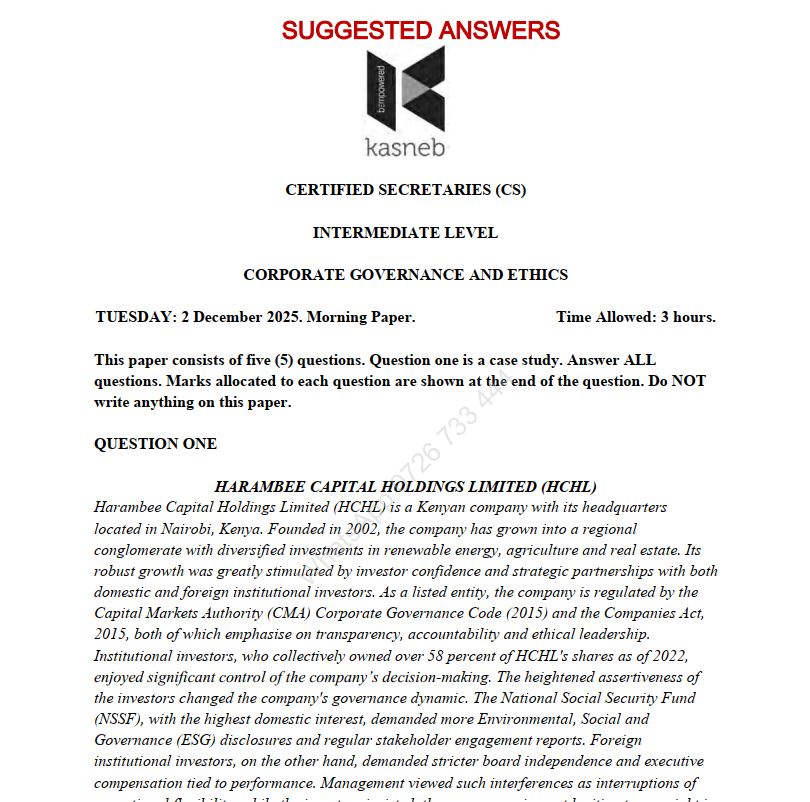
CERTIFIED SECRETARIES (CS) INTERMEDIATE LEVEL
CORPORATE GOVERNANCE AND ETHICS
TUESDAY: 2 December 2025. Morning Paper. Time Allowed: 3 hours.
This paper consists of five (5) questions. Question one is a case study. Answer ALL questions. Marks allocated to each question are shown at the end of the question. Do NOT write anything on this paper.
QUESTION ONE
HARAMBEE CAPITAL HOLDINGS LIMITED (HCHL)
Harambee Capital Holdings Limited (HCHL) is a Kenyan company with its headquarters located in Nairobi, Kenya. Founded in 2002, the company has grown into a regional conglomerate with diversified investments in renewable energy, agriculture and real estate. Its robust growth was greatly stimulated by investor confidence and strategic partnerships with both domestic and foreign institutional investors. As a listed entity, the company is regulated by the Capital Markets Authority (CMA) Corporate Governance Code (2015) and the Companies Act, 2015, both of which emphasise on transparency, accountability and ethical leadership.
Institutional investors, who collectively owned over 58 percent of HCHL’s shares as of 2022, enjoyed significant control of the company’s decision-making. The heightened assertiveness of the investors changed the company’s governance dynamic. The National Social Security Fund (NSSF), with the highest domestic interest, demanded more Environmental, Social and Governance (ESG) disclosures and regular stakeholder engagement reports. Foreign institutional investors, on the other hand, demanded stricter board independence and executive compensation tied to performance. Management viewed such interferences as interruptions of operational flexibility, while the investors insisted, they were carrying out legitimate oversight in order to safeguard shareholders’ interests. Such tension was an indication of the delicate balance between management discretion and investor-led accountability. It also reflected the increasing role of institutional investors in demanding ethical practices, sustainable investment norms and good corporate conduct from Kenya’s emergent capital markets.
In the year 2023, HCHL faced serious governance issue when a whistleblower raised concerns that certain top managers had manipulated project valuation data in order to inflate their performance bonuses. The report caught the interest of the CMA and Nairobi Securities Exchange (NSE), prompting the board to act with all due haste. The Audit and Risk Committee directed a forensic audit which revealed deficiencies in internal controls, inadequate segregation of duties and ineffective risk monitoring. The board sought to correct these by improving its oversight mechanisms through restructuring the internal audit department to report to the Audit and Risk Committee and not management. Further, the Chief Executive Officer (CEO) and Chief Financial Officer (CFO) were held personally accountable for financial reporting integrity. Annual board reviews were established to assess the performance of the directors as overseers. This reaffirmed the fiduciary duty of the board to ensure transparency, fairness and accountability in all corporate deals and helped demonstrate the fiduciary significance of the governance structure in safeguarding the stakeholders’ interests.
With business expansion to Uganda and Tanzania, the firm was confronted with cultural and regulatory disparity in ethical practices. In another, Tanzanian project agents made facilitation payments to hurry government permits. The proposal placed management in a position of ethical dilemma, especially since the practice was locally accepted even though it violated Kenyan anti-bribery guidelines. Acting on the principle of universality of ethics, the Board held that ethical conduct should not change in accordance with geography or context. It concluded that ethical standards weren’t something to be negotiated and required the same across all subsidiaries. The firm adopted a group-wide ethics awareness initiative, comprising regular training sessions and establishing an ethics hotline. This stressed that moral principles are everywhere and that the reputation of the company depended on constant moral standards regardless of jurisdiction.
In HCHL, business ethics are the values and standards guiding behaviour and decision-making in striving to meet company objectives honestly, fairly and with accountability. The firm brought this definition into action by developing a Code of Business Conduct that applies to all directors, employees and suppliers. The code prohibits conflict of interest, insider dealing and discrimination. It also adopted a whistleblower policy that gave security and confidentiality to employees who lodged reports of unethical behaviour. To compel ethical culture, the firm had ethics audits performed annually by outside consultants to assess compliance and recommend improvement. Ethical behaviour was also included in performance evaluations, linking managers’ bonuses to financial performance and ethical behaviour. such steps, HCHL demonstrated that business ethics are not abstractions but real practices based on corporate strategy.
After the governance crisis, HCHL adopted modern performance measurement techniques to enhance accountability and monitor the efficacy of ethical governance. The Balanced Scorecard became a focal point, combining financial, customer, internal process and ethical perspectives for a holistic performance assessment. Executives’ Key Performance Indicators (KPIs) were also revised to include ethical leadership indicators, sustainability indicators and stakeholder engagement indicators. An annual director evaluation matrix was also introduced by the Board that challenged individual performance, independence and compliance with governance standards. Stakeholder feedback surveys were also conducted to measure trust and reputation of the corporation. These interventions shift the focus of the company away from short-term profitability towards long-term value creation based on integrity and stakeholder trust.
The HCHL experience illustrates the indivisible link between corporate governance and ethics to continue business success. Institutional investors served as main accountability drivers, demanding transparency and responsibility from management. The corrective action taken by the Board in rectifying governance failures consolidated control mechanisms and restored stakeholder confidence. The firm’s adherence to international ethical standards globally reinforced its corporate reputation as a values-driven company. Finally, the application of performance measurement that monitors financial and ethical outcomes positions the company for long-term expansion. In a business environment where ethics blunders could easily undermine image, the experience of HCHL serves as a Kenyan paradigm for how ethical leadership and good governance are the foundation of long-term corporate resilience.
Required:
(a) Explain FIVE ways in which the board of directors demonstrated oversight and accountability following the governance scandal at HCHL. (10 marks)
(b) Describe FIVE principles of universality of ethics that were applied during HCHL’s regional expansion. (10 marks)
(c) In upholding business ethics, examine FIVE ways in which HCHL integrated ethical practices into its operations.
(10 marks)
(d) Assess FIVE performance evaluation tools that were adopted by HCHL to enhance its ethical governance and accountability. (10 marks)
(Total: 40 marks)
QUESTION TWO
(a) Outline FIVE causes of stakeholder disputes that boards must address under the environmental, social governance (ESG) framework. (5 marks)
(b) Identify FIVE assumptions of Agency Theory in the context of corporate governance. (5 marks)
(c) Examine FIVE limitations of traditional board governance model in modern corporate governance. (5 marks)
(Total: 15 marks)
QUESTION THREE
(a) Highlight FIVE pillars of good corporate governance in providing a strong foundation for organisational sustainability. (5 marks)
(b) Artificial Intelligence (AI) and emerging technologies are reshaping corporate decision-making, data use and stakeholder engagement worldwide.
With reference to the above statement, evaluate FIVE ethical risks and governance implications of adopting AI in corporate strategy and decision-making. (10 marks)
(Total: 15 marks)
QUESTION FOUR
(a) Explain FIVE reasons for executive succession planning to ensure good corporate governance. (5 marks)
(b) Analyse FIVE roles that codes of corporate governance play in enhancing internal governance structures within organisations. (5 marks)
(c) Examine FIVE ways in which transparency and disclosure promote an ethical corporate culture. (5 marks)
(Total: 15 marks)
QUESTION FIVE
(a) Discuss FIVE international regulatory frameworks that shape corporate governance practices globally.
(5 marks)
(b) Explain FIVE sources of compliance risks faced by organisations in corporate governance. (5 marks)
(c) Analyse FIVE ethical and governance concerns arising from insider trading in corporations. (5 marks)
(Total: 15 marks)
………………………………………………………………………………….
Related products
-
- Collection of CPA CS Company Law Pdf Past Paper Answers Topically and Yearly Arranged(September 2015 to AUGUST 2026)
Original price was: KSh1,200.KSh799Current price is: KSh799. Download -

December 2024 Meetings, Compliance and Administration Past Paper Answers
Original price was: KSh600.KSh299Current price is: KSh299. Download -
August 2024 CPA CS Company Law Past Paper answers
Original price was: KSh300.KSh199Current price is: KSh199. Download -

- Collection of Principles of Accounting and Taxation Pdf Past papers Answers (December 2021 to December 2024)
Download