Original price was: KSh600.KSh499Current price is: KSh499.
Download April 2026 Corporate Governance and Ethics Past Paper answers in Pdf form
Description
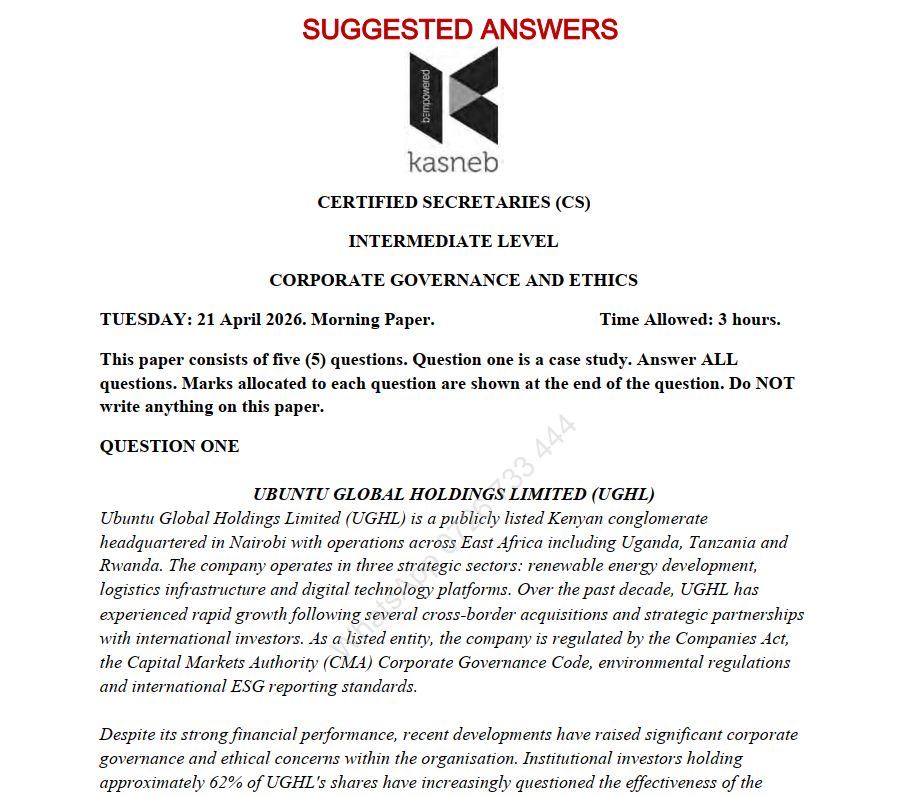
CERTIFIED SECRETARIES (CS) INTERMEDIATE LEVEL
CORPORATE GOVERNANCE AND ETHICS
TUESDAY: 21 April 2026. Morning Paper. Time Allowed: 3 hours.
This paper consists of five (5) questions. Question one is a case study. Answer ALL questions. Marks allocated to each question are shown at the end of the question. Do NOT write anything on this paper.
QUESTION ONE
UBUNTU GLOBAL HOLDINGS LIMITED (UGHL)
Ubuntu Global Holdings Limited (UGHL) is a publicly listed Kenyan conglomerate headquartered in Nairobi with operations across East Africa including Uganda, Tanzania and Rwanda. The company operates in three strategic sectors: renewable energy development, logistics infrastructure and digital technology platforms. Over the past decade, UGHL has experienced rapid growth following several cross-border acquisitions and strategic partnerships with international investors. As a listed entity, the company is regulated by the Companies Act, the Capital Markets Authority (CMA) Corporate Governance Code, environmental regulations and international ESG reporting standards.
Despite its strong financial performance, recent developments have raised significant corporate governance and ethical concerns within the organisation. Institutional investors holding approximately 62% of UGHL’s shares have increasingly questioned the effectiveness of the company’s governance structures. Some shareholders argue that the board has not exercised sufficient oversight over management decisions, particularly regarding major infrastructure projects, executive remuneration policies and risk management processes.
The governance structure of UGHL consists of a board of eleven directors, including four executive directors, five non-executive directors and two independent directors. However, several governance analysts have criticised the board composition, noting that two non-executive directors are former senior executives of the company while another has close business ties with the Chief Executive Officer (CEO). These relationships have raised concerns about the independence of board decisions and the board’s ability to provide objective oversight of management activities.
Tensions between management and shareholders intensified when a whistleblower from the finance department submitted a confidential report to the Audit and Risk Committee alleging irregularities in the company’s procurement processes. According to the report, several large infrastructure contracts had been awarded to companies linked to individuals with close relationships to senior executives. The whistleblower also alleged that project performance indicators were manipulated in order to meet performance targets that triggered significant executive bonuses.
The allegations further suggested that the company’s internal control systems were weak, procurement policies were frequently bypassed and risk management reports were sometimes altered before presentation to the board. Additionally, the internal audit function reported administratively to the Chief Financial Officer rather than directly to the Audit Committee, raising concerns about the independence of the audit process.
In response to the allegations, the Board of Directors established a special governance review committee consisting of independent advisors, legal experts and external auditors. Preliminary findings revealed deficiencies in segregation of duties within the procurement department, weak monitoring of compliance with corporate governance policies and inadequate oversight of executive performance incentives.
UGHL has also faced ethical challenges in its regional expansion strategy. In some neighbouring countries, project managers encountered regulatory environments where facilitation payments and informal negotiations were commonly used to expedite licensing approvals. Some managers argued that adopting these practices was necessary to remain competitive, while others insisted that such actions violated the company’s code of ethics and international anti-corruption standards. Stakeholders have also raised concerns about the company’s environmental and social governance (ESG) practices.
Community groups in Tanzania accused UGHL of failing to adequately consult local communities before acquiring land for an energy project. In Uganda, civil society organisations criticised the company for insufficient disclosure of environmental impact assessments and poor stakeholder engagement during project planning.
These developments attracted attention from regulators and international investors who increasingly expect corporations to demonstrate transparency, accountability and responsible business conduct.
In order to restore investor confidence and strengthen governance systems, the board has proposed several reforms including restructuring board committees, strengthening internal control systems, introducing independent performance evaluation mechanisms for directors and senior executives and improving disclosure practices related to sustainability and ethical compliance.
Required:
(a) The allegations and weaknesses in internal controls revealed governance deficiencies at UGHL.
With reference to the above statement, explain FIVE governance mechanisms that the Board of Directors of UGHL should implement to strengthen oversight, improve internal controls and prevent procurement irregularities.
(10 marks)
(b) During UGHL’s regional expansion, managers encountered environments where facilitation payments were commonly used to accelerate regulatory approvals.
With reference to the above statement, analyse FIVE ethical dilemmas UGHL may face when operating in different jurisdictions where local business practices conflict with the company’s code of ethics and international anti-corruption standards. (10 marks)
(c) Institutional investors and regulators have raised concerns about UGHL’s governance structure, board independence and ESG disclosure practices.
With reference to the above statement, evaluate FIVE ways in which strengthening corporate governance practices at UGHL could help restore investor confidence and improve stakeholder trust. (10 marks)
(d) Following the governance concerns and allegations of manipulation of performance indicators, UGHL’s board intends to introduce enhanced performance monitoring and evaluation systems for directors and senior executives.
In relation to the above statement, recommend FIVE performance evaluation tools that UGHL’s board could adopt to assess the performance of directors and senior management while promoting ethical governance. (10 marks)
(Total: 40 marks)
QUESTION TWO
(a) Analyse FIVE ways in which stakeholder theory influences board decision-making in modern corporate governance. (5 marks)
(b) Evaluate FIVE mechanisms that organisations can use to mitigate agency conflicts between shareholders and management. (10 marks)
(Total: 15 marks)
QUESTION THREE
(a) Explain FIVE ways in which corporate governance frameworks promote accountability in organisations.(5 marks)
(b) Assess FIVE ethical challenges associated with big data and digital transformation in organisations. (10 marks)
(Total: 15 marks)
QUESTION FOUR
(a) Identify FIVE roles of the board in overseeing risk management within an organisation. (5 marks)
(b) Explain FIVE ways in which organisational culture influences ethical behaviour in corporate governance.
(10 marks)
(Total: 15 marks)
QUESTION FIVE
(a) Analyse FIVE social responsibility initiatives that enhance stakeholder relations in an organisation. (5 marks)
(b) Discuss FIVE strategies that organisations can implement to strengthen compliance management systems.
(10 marks)
(Total: 15 marks)
………………………………………………………………………………
Related products
-
August 2024 CPA Introduction to Law and Governance Past Paper answers
Original price was: KSh500.KSh299Current price is: KSh299. Download -
December 2024 CPA Introduction to Law and Governance Past Paper answers
Original price was: KSh500.KSh299Current price is: KSh299. Download -
- Collection of Finance for Decision Making Pdf Past Papers Answers (December 2021 to AUGUST 2025)
Original price was: KSh1,200.KSh899Current price is: KSh899. Download -

- Collection of Financial Markets and Specialised Institutions Pdf Past Paper Answers (December 2021 to APRIL 2026)
Original price was: KSh1,200.KSh899Current price is: KSh899. Download