Original price was: KSh600.KSh499Current price is: KSh499.
Download April 2026 Public Sector Governance, Policy and Administration Past Paper answers in Pdf form
Description
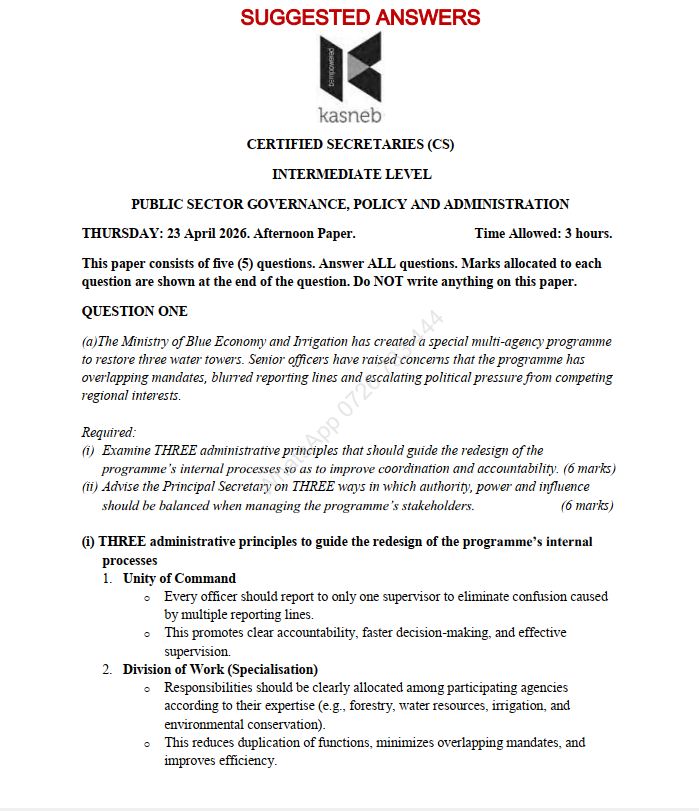
CERTIFIED SECRETARIES (CS) INTERMEDIATE LEVEL
PUBLIC SECTOR GOVERNANCE, POLICY AND ADMINISTRATION
THURSDAY: 23 April 2026. Afternoon Paper. Time Allowed: 3 hours.
This paper consists of five (5) questions. Answer ALL questions. Marks allocated to each question are shown at the end of the question. Do NOT write anything on this paper.
QUESTION ONE
(a) The Ministry of Blue Economy and Irrigation has created a special multi-agency programme to restore three water towers. Senior officers have raised concerns that the programme has overlapping mandates, blurred reporting lines and escalating political pressure from competing regional interests.
Required:
(i) Examine THREE administrative principles that should guide the redesign of the programme’s internal processes so as to improve coordination and accountability. (6 marks)
(ii) Advise the Principal Secretary on THREE ways in which authority, power and influence should be balanced when managing the programme’s stakeholders. (6 marks)
(b) Assess FOUR implications for public administration where the relationship between politics and administration is poorly managed in a devolved governance system. (8 marks) (Total: 20 marks)
QUESTION TWO
(a) Identify TWO ways in which county development plans (CDPs) should be aligned to national development frameworks when implementing development policies. (4 marks)
(b) A County government intends to introduce a Climate-Smart Agribusiness Policy to address food insecurity, youth unemployment and weak market access.
Required:
(i) Explain FOUR public policy models that could be considered in framing the proposed policy and explain the suitability within the context of the County. (8 marks)
(ii) Describe FOUR agenda-setting and policy-formulation steps that would help the county move from problem identification to an implementable draft policy. (8 marks) (Total: 20 marks)
QUESTION THREE
(a) A newly established metropolitan authority has received criticism that its citizen engagement is superficial, excludes informal traders and persons with disabilities and occurs too late to influence decisions.
Required:
(i) Summarise THREE participation modalities the authority should institutionalise in order to make engagement more inclusive and effective. (6 marks)
(ii) Analyse THREE likely consequences of weak stakeholder engagement on development planning and policy legitimacy. (6 marks)
(b) Discuss FOUR statutory or operational mechanisms that may be used to manage conflict and coordination between national and county governments during joint service-delivery projects. (8 marks) (Total: 20 marks)
QUESTION FOUR
(a) A state corporation responsible for regional transport logistics has recorded cost overruns, procurement disputes, delayed audit responses and rising debt-servicing obligations.
Required:
(i) Analyse THREE resource-stewardship controls that the board should strengthen to improve financial discipline and service delivery. (6 marks)
(ii) Examine THREE public-finance or public-procurement risks that could arise if these controls remain weak. (6 marks)
(b) Evaluate FOUR reform options available to government in improving the performance of an underperforming public enterprise without undermining public interest obligations. (8 marks) (Total: 20 marks)
QUESTION FIVE
(a) The Cabinet Secretary for Public Service has appointed you to advise an inter-governmental task force that is developing a national digital permits platform to be implemented by both levels of government. The proposal promises efficiency gains, but concerns have been raised about ethics, leadership culture, accountability, implementation readiness and post-implementation review.
Required:
(i) Explain FOUR governance and ethics measures that should be embedded at design stage to strengthen integrity, transparency and accountability. (8 marks)
(ii) Recommend THREE monitoring and evaluation indicators that would enable the task force to review policy implementation and outcomes after roll-out. (6 marks)
(b) Propose THREE leadership practices that would help sustain values-based implementation across the participating public entities. (6 marks)
(Total: 20 marks)
………………………………………………………………………………
Related products
-
August 2024 CPA Introduction to Law and Governance Past Paper answers
Original price was: KSh500.KSh299Current price is: KSh299. Download -
August 2024 CPA CS Company Law Past Paper answers
Original price was: KSh300.KSh199Current price is: KSh199. Download -

- Collection of Human Resources Management Pdf Past Papers Answers (December 2021 to APRIL 2026)
Original price was: KSh1,200.KSh899Current price is: KSh899. Download -
August 2024 ICT CPA CS Past Paper answers
Original price was: KSh300.KSh199Current price is: KSh199. Download