Original price was: KSh500.KSh299Current price is: KSh299.
Download December 2024 Strategic Management Past Paper answers in Pdf form
Description
CS ADVANCED LEVEL STRATEGIC MANAGEMENT
MONDAY: 2 December 2024. Morning Paper. Time Allowed: 3 hours.
Answer ALL questions. Marks allocated to each question are shown at the end of the question. Do NOT write anything on this paper.
QUESTION ONE
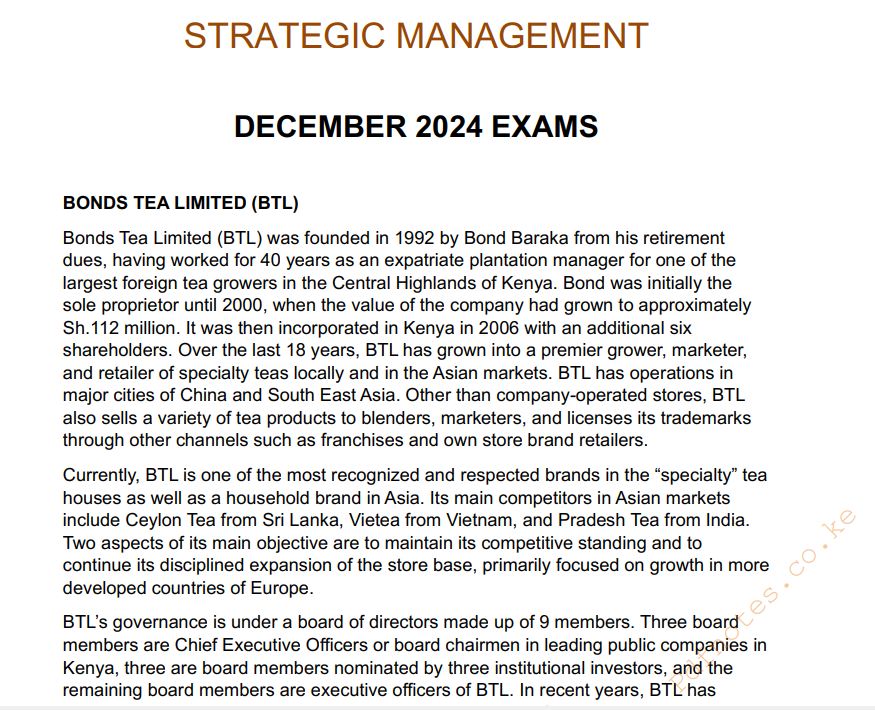
BONDS TEA LIMITED (BTL)
Bonds Tea Limited (BTL) was founded in 1992 by Bond Baraka from his retirement dues having worked for 40 years as an expatriate plantation manager for one of the largest foreign tea growers in the Central Highlands of Kenya. Bond was initially the sole proprietor until 2000 when the value of the company had grown to approximately Sh.112 million. It was then incorporated in Kenya in 2006 with an additional six shareholders. Over the last 18 years, BTL has grown into a premier grower, marketer and retailer of specialty teas locally and in the Asian markets. BTL has operations in major cities of China and South East Asia. Other than company-operated stores, BTL also sells a variety of tea product blenders, marketers and licenses its trademarks through other channels such as franchises and own store brand retailers.
Currently, BTL’s is one of the most recognised and respected brands in the “specialty” tea houses as well as household brand in Asia. Its main competitors in Asian markets include Ceylon Tea from Sri Lanka, Vietea from Vietnam and Pradesh Tea from India. Two aspects of its main objective are to maintain its competitive standing and to continue its disciplined expansion of the store base, primarily focused on growth in more developed countries of Europe.
BTL’s governance is under a board of directors made up of 9 members. Three board members are Chief Executive Officers or board chairmen in leading public companies in Kenya, three are board members nominated by three institutional investors and the remaining board members are executive officers of BTL. In recent years, BTL has adopted a global risk management strategy seeing that BTL’s most important markets are global and in order to ensure consistent and unified risk management policies, strategies and processes among its foreign operations. To implement the new risk management strategy, BTL recently hired a Chief Risk Manager to oversee implementation of the risk management strategy. In response to the new risk management strategy, BTL’s board hired an experienced global risk consultant, Global Risk Limited (GRL) to develop the risk management strategies for BTL and to ensure that these strategies fit in BTL’s global risk management strategy. GRL’s responsibilities include proper integration of risk management strategies and policies with the global strategies and policies, smooth and controlled implementation of these strategies and cultivation of an acceptable risk management culture for BTL facilitating its ultimate goal of becoming the top specialty tea producer and marketer globally. With this new strategy the board members cannot agree on which board committee should be given the responsibility of overseeing the work of GRL. Some board members feel that the Audit Committee’s role should be expanded to oversee this new risk management strategy while others believe that this new strategy involves significant strategic changes and should be the Executive Committee’s role. Some believe that it should be the role of the Finance Committee as the strategies will involve significant global financial transactions and exchange risks. The board of directors has requested GRL to consult with the Chief Risk Manager and provide a recommendation.
BTL faces significant supply-chain risks such as shipping costs, import restriction, currency and demand risks such as significant competitive pressures and change in consumer markets. It also faces operational risks, litigation and reputational risks and other market risks which include foreign currency exchange risk and interest rate risks.
BTL is a dominant player in the high-end specialty tea market especially through its premier teahouse outlets which have over a 30% market share in China. However, its market share in Europe that is done mostly through exports and franchise is barely 5%. There is significant growth potential in Europe and North America where the customer base is still expanding and represents a chance to increase market share without the pressure to take customers from competitors. BTL has also not tapped the African markets and signs are that demand for specialty tea is growing. BTL’s current marketing strategies are as follows:
• Maintain its dominant market position in the teahouses in China and South East Asia by organic expansion of its company-operated teahouses in these countries as well as expanding in more African and European countries where there is untapped potential through building more company-operated teahouses in financial districts and affluent areas.
• Enhance the company’s ability to quickly develop and roll out new and innovative products which helps defend against potential tea substitutes as well as serving to further differentiate BTL from its competitors. BTL is also exploring vertical integration in foreign markets in order to enhance its quality control as well as developing its own niche products.
• Further promote relationships with and loyalty from other distributors such as high-end hotels and large-scale retailers.
• Expand into more developing countries through acquisition of local teahouse chains, franchising and organic growth into more cities of the developing countries especially the fast-growing African and European market.
• Local advertising in all emerging markets to expand its household brand recognition as well as more endorsements with certain significant events such as the hospitality fairs, agricultural fairs events of regional significance.
• Maintain significant financial resources devoted to BTL’s renowned marketing capability which due to investments over many years, has achieved significant economies of scale and brand recognition.
During the Covid 19 pandemic in 2020, BTL suffered significant losses due to reduced market demand as well as significant investment losses. This was due to the overreliance on the Asian market which was the epicentre of the pandemic. This has made some board members to be very unhappy with the geographical market concentration leading to losses. Today, the Marketing Director for global markets is being empowered to implement the recent market strategic goals set by the board. His first priority is to expand into the fast growing African and European markets. This expansion strategy will require significant investment in capital. The new Chief Risk Manager is uneasy with the expansion strategy as cash flow in BTL will greatly be strained without additional debt financing which in turn increases the BTL’s leverage ratio above the financially acceptable level.
In addition, BTL is expanding its product lines such as the super-premium purple tea market and bubble teas and specialty fruit and mixed tea drinks that have given BTL a reputation as a product innovator in the market. To this end, BTL is exploring offering tea made from exotic and special tea leaves. There are very few areas that can produce such high quality premium teas other than Kenya. This gives BTL a clear competitive advantage.
The Asian country of Colombo has soil and climatic conditions that are very similar to Kenya and provides potential for BTL to develop growing and marketing opportunities there. Although Colombo has a market for specialty teas, its domestic consumption is very small. However there exists a huge potential for an export-driven economy.
Despite Colombo’s increased participation in international trade, 10 years ago Colombo put in place a policy to peg its currency to that of its neighbouring countries. The effect of this has been to effectively deflate the value of Colombo’s currency, the Rupia and as a consequence bolster Colombo’s export-driven economy. Independent economic analysis has suggested the deflation of Colombo’s currency has been instrumental to the growth of its economy. However, the banking system in Colombo is rudimentary with few international banks. The financial sector has been slow in modernising and all domestic banks primarily engage in domestic thrift activity and as a consequence, their risk management and currency risk management programs are in their early stages. Further, the central banking system still implements exchange controls.
The Colombo government is very eager to stabilise its economy and enjoy the economic boom that is currently being experienced in Asia. The government is willing to give an exclusive concession to BTL to grow and market premium specialty teas that will be grown, processed and marketed locally as well as for export markets. The government is also willing to give BTL concessionary long-term leases on land for the venture. The condition is that BTL sets up a complete value chain incorporating farming, processing, production and both local and foreign marketing facilities for these super-premium teas in Colombo. This presents a significant opportunity for BTL to gain favourable access to its key ingredient not easily duplicated by competitors, to reduce its reliance on the Kenyan production to serve the Asian market and to control costs as well as influence and control the quality of future specialty tea production. However, the Chief Risk Manager has cautioned the board to be slow in taking up the offer in light of past political instability in the country. However, this vertical integration strategy presents significant upfront cost requirements which may substantially increase the company’s leverage ratio and lower the overall credit rating for BTL.
Required:
(a) BTL followed an organic growth strategy.
Using the information in this case study and giving specific examples, describe FIVE disadvantages of this growth strategy. (10 marks)
(b) BTL is considering a vertically integrated business strategy in Colombo.
Citing examples from the case study, evaluate FIVE potential benefits of a vertical integration strategy.
(10 marks)
(c) Discuss FIVE political risks that BTL’s Board should consider in its international business entry into Colombo.
(10 marks)
(d) Strategic change introduces risk in an organisation.
Evaluate FIVE roles of BTL’s board in managing strategic risks. (10 marks)
(Total: 40 marks)
QUESTION TWO
(a) Highlight FOUR benefits of strategic control in a firm. (4 marks)
(b) Evaluate THREE challenges associated with benchmarking. (3 marks)
(c) Describe FOUR types of corporate level strategies. (8 marks)
(Total: 15 marks)
QUESTION THREE
(a) Outline THREE circumstances under which autocratic leadership style may be appropriate. (3 marks)
(b) Highlight FOUR reasons for strategic drift in an organisation. (4 marks)
(c) Analyse FOUR ways in which culture influences strategy in an organisation. (8 marks)
(Total: 15 marks)
QUESTION FOUR
(a) Differentiate between “plans” and “programs”. (2 marks)
(b) Examine THREE applications of game theory in business interactive strategies. (3 marks)
(c) Explain FIVE advantages of strategic planning in an organisation. (10 marks)
(Total: 15 marks)
QUESTION FIVE
(a) Outline FIVE components of a mission statement. (5 marks)
(b) Analyse FIVE factors that influence an organisation structure. (10 marks)
(Total: 15 marks)
……………………………………………………………………………………………………..
Related products
-

- Collection of Boardroom Dynamics Pdf Past Papers Answers (December 2021 to APRIL 2026)
Original price was: KSh1,200.KSh899Current price is: KSh899. Download -

- Collection of Principles of Accounting and Taxation Pdf Past papers Answers (December 2021 to December 2024)
Download -

December 2024 Human Resource Management Past Paper Answers
Original price was: KSh500.KSh299Current price is: KSh299. Download -

December 2024 Meetings, Compliance and Administration Past Paper Answers
Original price was: KSh600.KSh299Current price is: KSh299. Download