Original price was: KSh600.KSh299Current price is: KSh299.
Download December 2024 Corporate Governance and Ethics Past Paper answers in Pdf form
Description
CS INTERMEDIATE LEVEL CORPORATE GOVERNANCE AND ETHICS
TUESDAY: 3 December 2024. Morning Paper. Time Allowed: 3 hours.
Answer ALL questions. Marks allocated to each question are shown at the end of the question. Do NOT write anything on this paper.
QUESTION ONE
KILELE ENERGY LIMITED (KEL)
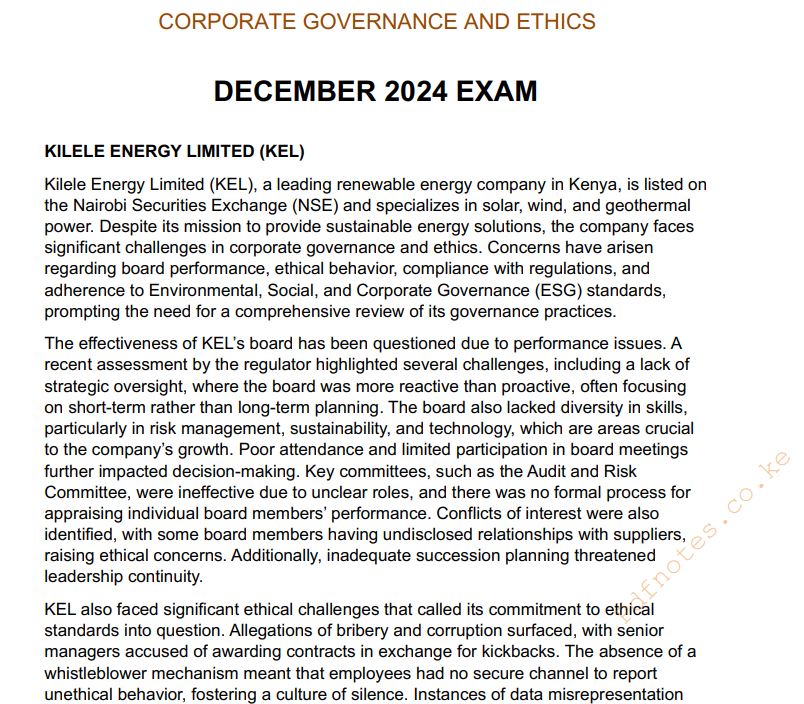
Kilele Energy Limited (KEL), a leading renewable energy company in Kenya, is listed in the Nairobi Securities Exchange (NSE) and specialises in solar, wind and geothermal power. Despite its mission to provide sustainable energy solutions, the company faces significant challenges in corporate governance and ethics. Concerns have arisen regarding board performance, ethical behaviour, compliance with regulations and adherence to Environmental, Social and Corporate Governance (ESG) standards, prompting the need for a comprehensive review of its governance practices.
The effectiveness of KEL’s board has been questioned due to performance issues. A recent assessment by the regulator highlighted several challenges, including lack of strategic oversight, where the board was more reactive than proactive, often focusing on short-term rather than long-term planning. The board also lacked diversity in skills, particularly in risk management, sustainability and technology which are areas crucial to the company’s growth. Poor attendance and limited participation in board meetings further impacted decision-making. Key committees, such as the Audit and Risk Committee, were ineffective due to unclear roles and there was no formal process for appraising individual board members’ performance. Conflicts of interest were also identified, with some board members having undisclosed relationships with suppliers, raising ethical concerns. Additionally, inadequate succession planning threatened leadership continuity.
KEL also faced significant ethical challenges that called its commitment to ethical standards into question. Allegations of bribery and corruption surfaced, with senior managers accused of awarding contracts in exchange for kickbacks. The absence of a whistleblower mechanism meant that employees had no secure channel to report unethical behaviour, fostering a culture of silence. Instances of data misrepresentation were uncovered, with financial and operational information manipulated to present a favorable company image. Unethical labour practices, including unsafe working conditions and delayed wage payments for contract workers, were also reported. Leadership failed to model ethical behaviour, creating a disconnect between the company’s values and practices. Furthermore, breaches of confidentiality and inconsistent enforcement of the code of conduct led to preferential treatment for some employees.
Compliance with laws and regulations was another major issue for KEL. The company faced multiple fines for environmental violations, including poor waste management and failure to meet emissions standards. KEL struggled with NSE listing requirements, frequently failing to report financial statements on time. The company’s risk management framework was inadequate, particularly in areas like cybersecurity and data protection, leading to compliance gaps. Licensing issues arose, with some sites operating without proper permits, exposing the company to legal action. Violations of labour laws, particularly around employee contracts and working hours, were also noted, along with discrepancies in tax filings, raising accusations of underreporting income. Employees were not adequately trained on compliance, contributing to frequent unintentional regulatory violations.
KEL’s commitment to ESG principles was inconsistent, posing reputational risks. Despite its focus on renewable energy, poor environmental practices, including inadequate waste management were identified. The company’s engagement with local communities was minimal, leaving residents feeling excluded from decision-making processes. Social investment was limited and Corporate Social Responsibility (CSR) reporting lacked transparency, making it hard to assess the impact of CSR initiatives. Gender and diversity issues persisted, particularly in leadership roles, with no clear policies to promote inclusivity. Environmental audits were poorly conducted, failing to identify key risks and the company lagged in aligning with global ESG standards, affecting its appeal to international investors. Addressing all these issues is crucial for the company to enhance governance standards, rebuild stakeholder trust and position itself as a responsible leader in Kenya’s renewable energy sector.
Required:
(a) Explain FIVE challenges affecting KEL’s board performance and effectiveness. (10 marks)
(b) Discuss FIVE ethical challenges KEL faced that could have negatively impacted its integrity. (10 marks)
(c) Explain FIVE compliance problems that KEL faced in its operations. (10 marks)
(d) From the case study, ESG difficulties impacted KEL’s sustainability and stakeholder relations.
Analyse FIVE of these difficulties. (10 marks)
(Total: 40 marks)
QUESTION TWO
(a) Describe FOUR benefits of effective corporate governance practices to an organisation. (4 marks)
(b) Summarise FIVE assumptions of the legitimacy theory. (5 marks)
(c) Analyse SIX benefits of an advisory board to an organisation. (6 marks)
(Total: 15 marks)
QUESTION THREE
(a) Strategic risks can significantly impact an organisation’s ability to achieve its long-term objectives and maintain its competitive position.
In reference to the above statement, outline FIVE strategies that board of directors could use to mitigate these risks. (5 marks)
(b) Describe FIVE components of board procedures. (5 marks)
(c) Explain FIVE factors that organisations should consider to ensure effectiveness of code of ethics. (5 marks)
(Total: 15 marks)
QUESTION FOUR
(a) The term, “Environmental, Social and Governance” first came to prominence in a 2004 report titled#8220;Who Cares Wins”, which was a joint initiative of financial institutions at the invitation of the United Nations.
In reference to the above statement, identify FIVE social factors that may be included in this framework.
(5 marks)
(b) The Board of directors plays a crucial role in promoting and maintaining an ethical culture within an organisation.
In view of the above statement, highlight FIVE such roles. (5 marks)
(c) XYZ Ltd. has introduced a compliance strategy in its operations.
Explain FIVE benefits of this move. (5 marks)
(Total: 15 marks)
QUESTION FIVE
(a) Identify THREE principles of professional ethics. (3 marks)
(b) Assessing the performance of a board of directors provides valuable opportunities to identify strengths, address weaknesses and enhance governance oversight.
In view of the above statement, explain FIVE areas of focus in a board evaluation. (5 marks)
(c) Strategic risk refers to potential threats or uncertainties that could significantly impact an organisation’s ability to achieve its long-term objectives and overall mission.
With reference to the above statement, outline SEVEN such strategic risks. (7 marks)
(Total: 15 marks)
………………………………………………………………………………….
Related products
-

- Collection of CPA Introduction to Law and Governance Pdf Past Paper Answers (December 2021 to APRIL 2026)
Original price was: KSh899.KSh699Current price is: KSh699. Download -

- Collection of Human Resources Management Pdf Past Papers Answers (December 2021 to APRIL 2026)
Original price was: KSh1,200.KSh899Current price is: KSh899. Download -

- Collection of Public Sector Governance, Policy and Administration Pdf Past Paper Answers (December 2021 to APRIL 2026)
Original price was: KSh1,200.KSh899Current price is: KSh899. Download -
December 2024 CPA Introduction to Law and Governance Past Paper answers
Original price was: KSh500.KSh299Current price is: KSh299. Download