Original price was: KSh600.KSh399Current price is: KSh399.
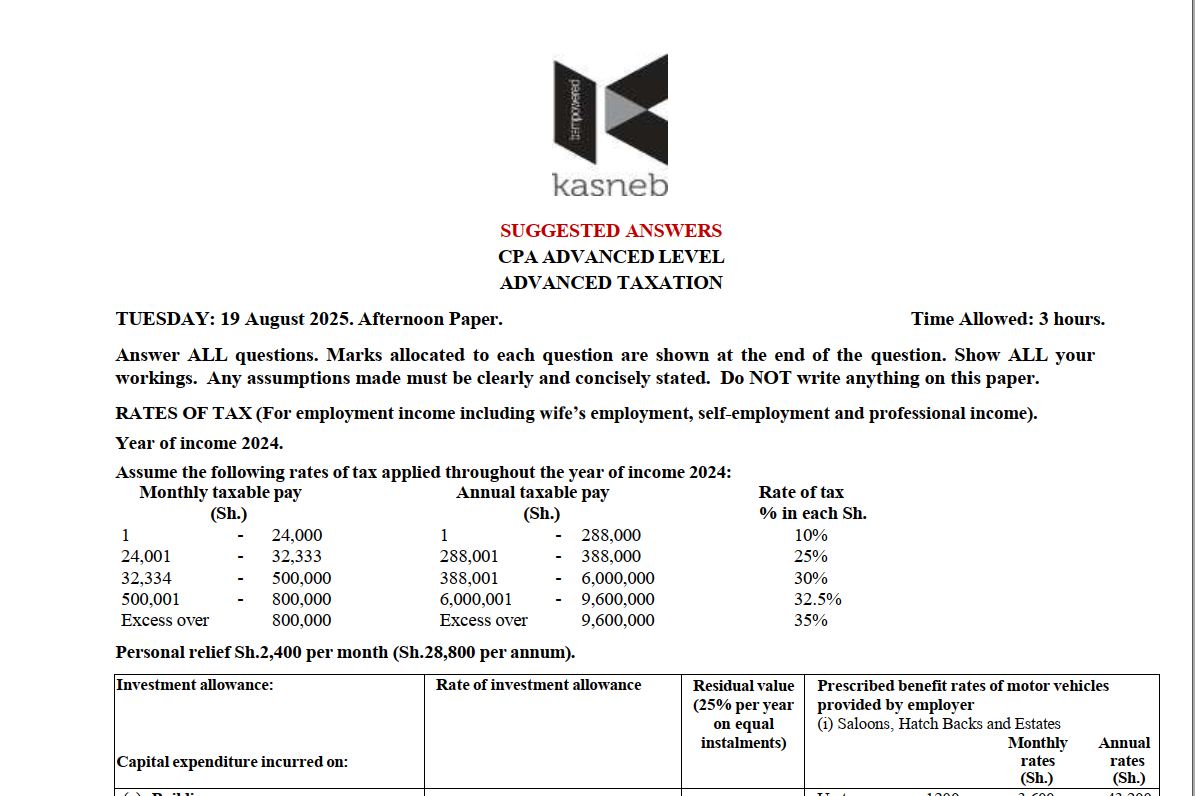
Download August 2025 CPA Advanced Taxation Answers in Pdf Form
Description
QUESTION ONE
(a) You have been appointed as a tax advisor to a contractor involved in infrastructure projects for a County Government. The contractor has recently received conflicting tax assessment from both the Revenue Authority relating to withholding tax and County Government relating to contractual service levy. The contractor believes the charges are duplicative and not grounded in clear provisions. The delays in resolving the dispute have stalled payments and strained the contractor’s cash flows.
Required:
(i) Explain the tax dispute resolution mechanism available to the contractor under Kenyan tax laws. (4 marks)
(ii) Advise the contractor on the steps to take in resolving the tax dispute with the Revenue Authority and County Government. (4 marks)
(iii) Propose FOUR institutional reforms that the County Government could implement to avoid similar tax disputes with contractors in the future. (4 marks)
(b) Barani Enterprises Ltd. is a value added tax (VAT) registered business involved in the sale and distribution of both taxable and exempt supplies. The following transactions were recorded in the books of the company for the month of April 2025:
April 2: Sales at standard rate Sh.1,160,000.
April 4: Sales made as exempt supply Sh.400,000.
April 6: Purchase of goods for resale on credit Sh.580,000. April 9: Purchase of stationery on credit Sh.116,000.
April 12: Purchase of fuel for company car Sh.87,000.
April 15: Payment for entertainment expenses for clients Sh.58,000. April 18: Purchase of a saloon car for director Sh.1,160,000.
April 20: Imported raw materials with customs and VAT paid Sh.232,000. April 22: Repairs to delivery truck used exclusively for distribution Sh.58,000.
April25: Purchase of goods used in both exempt and taxable supplies for Sh.348,000. April 28: Rent for business premises to a landlord registered for VAT Sh.116,000.
Additional information:
1. The company uses turnover-based apportionment for input VAT on mixed-use items.
2. Transactions are inclusive of value added tax (VAT) at the rate of 16%where applicable.
Required:
(i) Compute the output VAT for the month of April 2025. (2 marks)
(ii) Determine the total input VAT incurred and identify which amounts are restricted under the VAT Act, 2013. (3 marks)
(iii) Calculate the allowable input VAT claimable. (1 mark)
(iv) Compute the VAT payable or refundable for the month of April 2025. (2 marks)
(Total: 20 marks)
QUESTION TWO
(a) Treaty policies are central in shaping a country’s external tax relations, facilitating trade and investments and ultimately fostering economic co-operation. However, their implementation is subject to hurdles which affect the realisation of their objectives.
Required:
Evaluate FOUR structural hinderances to the implementation of tax treaty policies in your country. (4 marks)
(b) Mikah and Janace have been running a partnership business by the name “Jakah Enterprises” from 1 January 2023. They share profits and losses equally having contributed total capital of Sh.6,800,000. They have not been keeping proper books of accounts and have approached you to assist in the computation of their tax liability for the year ended 31 December 2024.
The following details were provided:
1. They sell goods on both cash and credit terms. During the year ended 31 December 2024, they sold 148,300 units on cash basis at a price of Sh.80 per unit.
2. An extract from the statement of financial position as at 31 December 2023 included the following non-current assets:
Asset Cost Accumulated depreciation Net book value
Sh.“000” Sh.“000” Sh.“000”
Land and office building
(Land Sh.1,500,000) 7,000 1,000 6,000
Plant and equipment 9,000 4,000 5,000
Furniture and fittings 2,000 1,000 1,000
3. Extract of current account had the following balances:
31 December 2023 31 December 2024
Sh.“000” Sh.“000”
Trade debtors 1,708,000 6,460,000
Bank 3,068,000(Credit) 4,169,900 (Debit)
Trade creditors 1,340,000 1,868,600
Subscriptions prepaid 200,000 140,000
Salaries owing 380,000 950,000
Electricity accrued 248,200 196,800
Inventory in trade 1,400,000 620,000
4. Payments through the bank were as follows:
Sh.
Cash purchases 3,188,000
Purchase of furniture 204,000
Catering service inclusive of VAT 180,000
Motor vehicle fuel inclusive of VAT 260,000
Electricity 184,600
Salaries (partners’ salaries Sh.900,000) 1,830,000 Legal fees 138,500
Subscriptions paid 200,000
5. Legal fees included Sh.30,500 relating to acquisition of freehold land and office building while electricity paid during the year included a deposit of Sh.40,000.
6. The capital contribution ratio was 3:1 for Mikah and Janace respectively. The partners are entitled to an interest of 10% and 8% per annum of capital contribution for Mikah and Janace respectively.
7. On 1 April 2024, the partnership obtained a bank loan of Sh.2,500,000. The interest rate was 18% per annum. The loan was repayable in 5 equal annual installments but had already fallen into arrears.
8. The partnership was converted into Jaykay Ltd. company on 1 September 2024 under the following terms:
• The partners were issued with ordinary shares equivalent to capital contribution in the partnership as at the date of conversion.
• They invited John to be a shareholder upon contribution of Sh.5,000,000 towards ordinary share capital and 8% debenture in the ratio of 3:2.
• The partners were to become the directors of the company earning a salary of Sh.40,000 each per month. This is not included in the salaries for the year.
• Land and buildings were revalued to Sh.10,500,000.
9. They purchased a saloon car on 1 October 2024 for Sh.3,300,000 which had 2800cc and computers for Sh.320,000 net of cash discounts of Sh.15,000.
10. Discount received from suppliers during the year amounted to Sh.720,000 while in November 2024, a debtor owing Sh.68,000 was declared bankrupt.
11. Subscriptions were made to Chamber of Commerce.
12. All sales and purchases were inclusive of VAT at the rate of 16%.
13. All revenue and expenses accrued evenly throughout the year unless otherwise stated.
Required:
(i) In a columnar format, determine the taxable income of the partnership and Jaykay Ltd. for the year ended 31 December 2024. (12 marks)
(ii) Compute taxable income of each partner for the year ended 31 December 2024. (3 marks)
(iii) Compute tax payable (if any) by Jaykay Ltd. for the year ended 31 December 2024. (1 mark)
(Total: 20 marks)
QUESTION THREE
(a) As a regional trade consultant working with the East African Community (EAC) secretariat, explain FOUR ways on how the implementation of One Stop Border Posts (OSBPs) have contributed to the growth of regional trade in East Africa. (8 marks)
(b) Western Mining Ltd. is a company involved in the exploration and extraction of gold and other precious minerals in Kakamega County. The following is the statement of profit or loss and other comprehensive income for the year ended 31 December 2024:
Western Mining Ltd.
Statement of profit or loss and other comprehensive income for the year ended 31 December 2024
Sh.“000” Sh.“000”
Revenue (export of goods) 600,000
Cost of sales:
Extraction costs (labour, fuel, blasting, water) (220,000)
Depreciation#8211; Mining equipment (50,000)
Royalties paid to Ministry of Mining (4% of sales) (24,000)
Site restoration provision (10,000)
Gross profit 296,000
Operating expenses:
Salaries and wages 40,000
Administration and head office expenses 30,000
Amortisation of exploration license 8,000
Impairment loss on mine development assets 6,000
Legal fines for environmental violations 2,000
Advertising and marketing expenses 5,000 (91,000)
Operating profit 205,000
Finance costs (interest on loan from bank) (10,000)
Tax expense (58,500)
136,500
Other compressive income:
Revaluation gain on freehold mining land 20,000
Exchange loss on translation of foreign operations (3,000)
Total comprehensive income
Additional information: 153,500
1. The company incurred Sh.15,000,000 in construction of roads within the mining site and Sh.12,000,000 in acquiring drilling equipment during the year.
2. The exploration license is valid for 4 years commencing 1 January 2023.
3. The site restoration provision is based on an estimated costs to be incurred in year 2025.
4. The company made a donation of Sh.3,000,000 to a local school project (not approved by the cabinet secretary). This amount was included in administration and head office expenses.
5. The company claimed revaluation gain on freehold land on equity but did not sell or dispose of the land.
6. The legal fine resulted from non-compliance with environmental regulations under the Mining Act.
7. Deprecation was computed using International Financial Reporting Standards (IFRS) rules and not aligned with investment allowances under the Income Tax Act.
Required:
(i) Prepare statement of adjusted taxable profit or loss for Western Mining Ltd. for the year ended 31 December 2024. (8 marks)
(ii) Determine the corporate tax, if any, payable by the company for the year ended 31 December 2024.
(2 marks)
(iii) Identify TWO obligations of mining companies operating in Kenya under the Income Tax Act. (2 marks)
(Total: 20 marks)
QUESTION FOUR
(a) During a tax seminar on “mitigating tax exposures”, the key note speaker observed that tax risk management plays a critical role in the development of tax planning strategies for an organisation.
Required:
(i) Summarise FOUR ways that a tax professional could use to quantify tax risk in an organisation. (4 marks)
(ii) Evaluate FOUR roles of tax risk management in the development of tax planning strategies of an organisation. (4 marks)
(b) In an era of evolving tax framework, self-regulation of tax professionals by recognised professional bodies is an important component of the countries tax administration system in maintaining the integrity of the tax system.
Required:
Analyse FOUR benefits of having self-regulation of tax professionals by professional bodies over government oversight. (4 marks)
(c) Robert Mwema is a senior software engineer at Steel Ltd. and has provided the following details for the year ended 31 December 2024:
1. His gross monthly salary is Sh.250,000 which includes a house allowance Sh.70,000 per annum.
2. He owns 15% shares in Innovatech Ltd., a private consulting company where he receives annual dividend of Sh.600,000.
3. He resides in a house he purchased through a personal loan of Sh.1,500,000 obtained from a bank on 1 September 2023 at an interest rate of 14% per annum repayable over 8 years.
4. He contributes Sh.18,000 per month to a Sacco investment account towards his retirement.
5. He has taken a ten-year education insurance policy where he contributes Sh.3,500 per month for his two children’s university education.
6. Robert Mwema has invested Sh.6,000,000 in a fixed deposit account and 15-year government infrastructure bond on equal basis both earning an annual interest at the rate of 12%.
7. He also owns a rental apartment, which generates monthly rental income of Sh.80,000 but incurs annual maintenance expenses of Sh.120,000 and county land rates of Sh.24,000.
Required:
Advise Robert Mwema on FOUR tax planning strategies that he could implement to optimise his tax position and legally minimise his annual tax liability from the information provided above. Support your argument with relevant computations where necessary. (8 marks)
(Total: 20 marks)
QUESTION FIVE
(a) In the context of tax compliance and advisory, the roles of a tax agent and tax representative are different yet they overlap.
With reference to the above statement, explain TWO distinguishing factors between a “tax agent” and a “tax representative”. (4 marks)
(b) Tax amnesty programs are used by countries in formulating tax policies to encourage tax compliance.
In relation to the above statement, evaluate FOUR limitations of using tax amnesty by a country. (4 marks)
(a) Brick Ltd. engages in construction of both residential and commercial building projects. For the year ended 31 December 2024, the company provided the following details:
1. Purchased 50 acres of land for Sh.2,500,000 per acre in a prime area designated for mixed use development.
2. Cost of environmental impact assessment amounted to Sh.3,200,000 while legal and conveyance fee totalled to Sh.4,800,000.
3. The company constructed 150 residential units on a 40 acre piece of land at a cost of Sh.1,200,000 per unit. This consisted of material and labour cost only.
4. All residential units were sold at Sh.2,800,000 each during the year 2024.
5. Material cost for each residential unit was Sh.800,000 which included VAT at the rate of 16%.
6. Professional fees paid to architects and engineers for the construction inclusive of VAT totalled to Sh.600,000 and Sh.300,000 respectively.
7. A sewerage and water supply system for the entire 50 acre land was installed at a cost of Sh.1,200,000.
8. Interest on a loan for acquiring the 50 acre of land amounted to Sh.6,500,000.
9. Heavy equipment hire costs for the residential development including bulldozers and cranes was Sh.1,000,000 for each of the six months used in the construction.
10. Fees paid to the government for planning and development approvals amounted to Sh.500,000.
11. The company build a 10,000 square metre commercial shopping complex on the remaining 10 acres of land at a cost of Sh.16,800,000 which was rented out on 1 August 2024 at a monthly rent of Sh.960,000.
12. The costs related to the entire land are to be allocated based on land acres used.
Required:
(i) Prepare the statement of adjusted taxable income or loss for Brick Ltd. for the year ended 31 December 2024. (11 marks)
(ii) Compute the tax payable, if any, by the company for the year ended 31 December 2024. (1 mark)
(Total: 20 marks)
………………………………………………………………………
Related products
-
- August 2024 Advanced Financial Management Answers
Original price was: KSh300.KSh199Current price is: KSh199. Download -

- Collection of CPA Financial Management Past Paper Answers(September 2015 upto APRIL 2026)
Original price was: KSh1,200.KSh899Current price is: KSh899. Download -
Advanced Financial Management May 2015 Past Paper and Answers
Original price was: KSh399.KSh199Current price is: KSh199. Download -
August 2024 CPA Financial Management Past Paper answers
Original price was: KSh600.KSh399Current price is: KSh399. Download