Original price was: KSh600.KSh499Current price is: KSh499.
Download April 2026 Leadership and Management Answers in Pdf form
Description
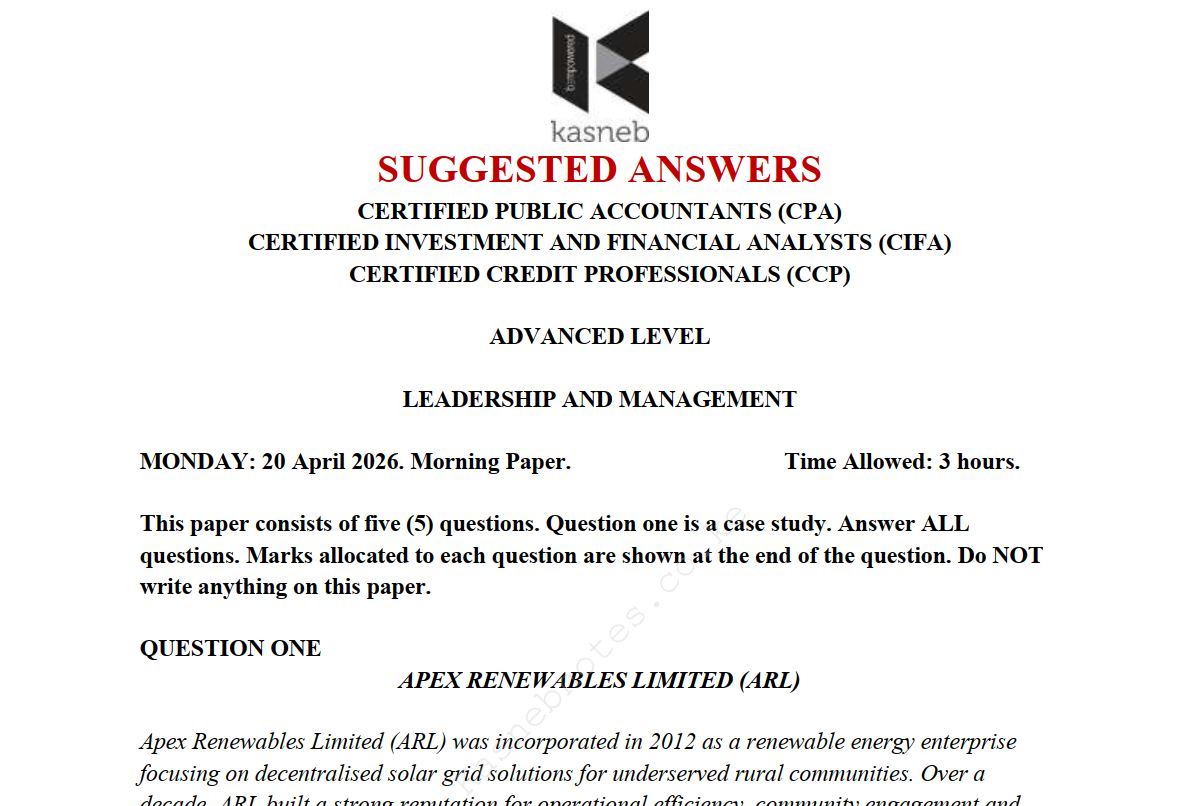
MONDAY: 20 April 2026. Morning Paper. Time Allowed: 3 hours.
This paper consists of five (5) questions. Question one is a case study. Answer ALL questions. Marks allocated to each question are shown at the end of the question. Do NOT write anything on this paper.
QUESTION ONE
APEX RENEWABLES LIMITED (ARL)
Apex Renewables Limited (ARL) was incorporated in 2012 as a renewable energy enterprise focusing on decentralised solar grid solutions for underserved rural communities. Over a decade, ARL built a strong reputation for operational efficiency, community engagement and innovative engineering design. 2022, the company had connected over 20,000 households to clean energy systems and developed partnerships with county governments and micro-financing institutions. Its consistent growth attracted international climate financing institutions, culminating in a Sh.2.5 billion infrastructure grants in 2023 to finance “Project Horizon,” an offshore wind energy initiative intended to power three major industrial cities. The project represented a strategic shift from community-based solar installations to capital-intensive, technology driven large-scale infrastructure development.
Project Horizon required specialised marine engineering capabilities, integration of real-time digital monitoring systems, coordination with port authorities and environmental regulators and complex stakeholder management across national and local government agencies. It also demanded sophisticated forecasting of industrial electricity demand and alignment with evolving green energy policies. To lead this transition, the Board appointed a new Chief Executive Officer (CEO), Silas Mbali, who had extensive experience in heavy manufacturing operations but limited exposure to renewable energy markets or public-private infrastructure partnerships. The Board maintained a largely strategic role, convening quarterly meetings and relied heavily on executive reports to monitor progress.
Under Mbali’s leadership, the project adopted an accelerated implementation schedule intended to demonstrate rapid results to donors and industrial clients. Preliminary feasibility studies were conducted but were limited in scope, particularly regarding coastal environmental risks, regulatory compliance requirements and competitive positioning against emerging renewable energy firms. Strategic planning assumptions were based primarily on historical solar-grid performance rather than offshore wind market dynamics. The CEO centralised major operational and financial decisions at headquarters and introduced strict reporting procedures for regional managers. While intended to improve accountability, these measures reduced managerial discretion and slowed responsiveness to emerging site-specific challenges.
As implementation progressed, coordination difficulties began to emerge. Engineering teams reported supply chain delays linked to specialised turbine components sourced internationally. Risk analysts raised concerns about new coastal protection legislation and marine biodiversity compliance standards that had recently been introduced. At the same time, the marketing division struggled to provide reliable industrial demand projections due to fluctuating energy prices and policy incentives favoring distributed solar solutions. Internal communication channels became increasingly formalised, limiting cross-functional collaboration between engineering, finance, marketing and regulatory affairs departments.
Financially, the project experienced mounting cost pressures. Currency volatility affected imported equipment pricing, while delays in grid integration increased capital expenditure beyond original projections. Only 35% of turbines were operational within the planned timeframe and performance testing revealed technical inefficiencies linked to inadequate environmental baseline surveys. Stakeholders, including industrial customers and regulatory authorities, expressed concerns regarding reliability and long-term sustainability. Although donor funding remained in place, periodic compliance reviews highlighted weaknesses in governance oversight, strategic risk management and performance monitoring mechanisms.
early 2026, shareholder confidence had weakened and media scrutiny intensified. The Board initiated an internal review to assess weaknesses in strategic planning, organisational structure, environmental scanning and project governance. An interim executive committee has since been appointed to stabilise ARL’s operations, re-evaluate its strategic direction and restore stakeholder confidence. The committee faces the challenge of redesigning governance systems, strengthening management controls, rebuilding cross-functional coordination and repositioning ARL within an increasingly competitive renewable energy market.
Required:
(a) Summarise FOUR deficiencies in ARL’s organisational structure that limited effective project execution. (8 marks
(b) Explain FIVE weaknesses in the planning function that contributed to the failure of Project Horizon. (10 marks)
(c) Examine FOUR governance failures of the Board in overseeing strategic direction in ARL. (8 marks)
(d) Evaluate THREE project management weaknesses that affected project performance in ARL. (6 marks)
(e) Analyse FOUR external environmental factors that ARL failed to integrate into its strategic decisions. (8 marks)
(Total: 40 marks)
QUESTION TWO
(a) Using suitable examples, outline FIVE challenges managers may face when delegating authority. (5 marks)
(b) Evaluate FIVE differences between classical management theory and behavioural management theory in influencing managerial practice. (10 marks)
(Total: 15 marks)
QUESTION THREE
(a) Highlight THREE challenges organisations may face when entering international markets. (3 marks)
(b) Explain TWO interpersonal roles performed by managers in organisations as advocated by Henry Mintzberg. (4 marks)
(c) Evaluate FOUR leadership approaches that enhance strategic change implementation. (8 marks)
(Total: 15 marks)
QUESTION FOUR
(a) As a leader in an enterprise, explain FIVE methods you may apply to enhance creativity and innovation. (5 marks)
(b) Analyse FIVE decision making models applicable under conditions of uncertainty. (10 marks)
(Total: 15 marks)
QUESTION FIVE
(a) Explain FIVE mechanisms for managing resistance to organisational change. (5 marks)
(b) Analyse FIVE ways in which e-commerce has transformed marketing activities. (10 marks)
(Total: 15 marks)
………………………………………………………………………………
Related products
-
- August 2024 Advanced Financial Management Answers
Original price was: KSh300.KSh199Current price is: KSh199. Download -

Advanced Financial Management November 2017 Past Paper and Answers
Original price was: KSh399.KSh199Current price is: KSh199. Download -
August 2024 CPA Advanced Auditing and Assurance Past papers with answers
Original price was: KSh600.KSh299Current price is: KSh299. Download -

Advanced Financial Management November 2018 Past Paper and Answers
Original price was: KSh399.KSh199Current price is: KSh199. Download