Original price was: KSh600.KSh499Current price is: KSh499.
Download April 2026 Financial Markets and Specialised Institutions Past Paper answers in Pdf form
Description
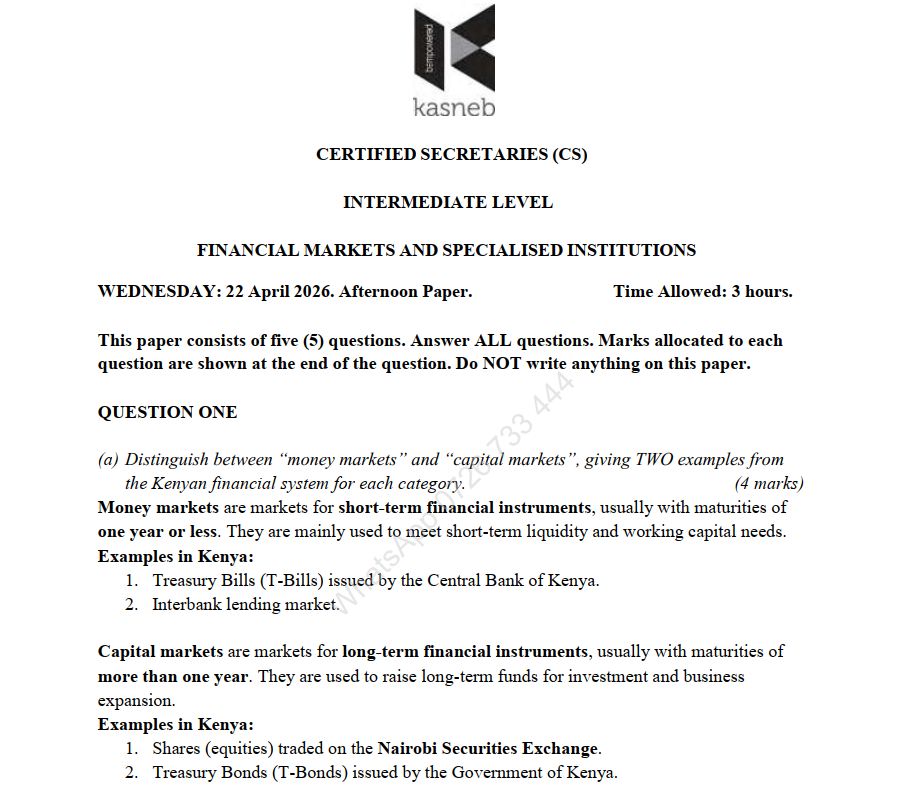
CERTIFIED SECRETARIES (CS) INTERMEDIATE LEVEL
FINANCIAL MARKETS AND SPECIALISED INSTITUTIONS
WEDNESDAY: 22 April 2026. Afternoon Paper. Time Allowed: 3 hours.
This paper consists of five (5) questions. Answer ALL questions. Marks allocated to each question are shown at the end of the question. Do NOT write anything on this paper.
QUESTION ONE
(a) Distinguish between “money markets” and “capital markets”, giving TWO examples from the Kenyan financial system for each category. (4 marks)
(b) Explain THREE roles played by microfinance banks in Kenya in supporting Small and Medium-sized Enterprises (SMEs). (6 marks)
(c) Examine TWO benefits of an automated trading system (ATS) at a securities exchange. (4 marks)
(d) Analyse THREE differences between “Treasury bonds” and “corporate bonds” as investment instruments.
(6 marks)
(Total: 20 marks)
QUESTION TWO
(a) Differentiate between “listing by introduction” and “offer by tender” as methods of listing securities. (4 marks)
(b) Analyse FOUR disclosures that should appear in a prospectus for a public offer of shares in Kenya. (8 marks)
(c) Highlight TWO implications of a rights issue to:
(i) An existing shareholder who does not take up the rights. (2 marks)
(ii) An existing shareholder who takes up the rights in full. (2 marks)
(d) Evaluate TWO International Organisation of Securities Commissions (IOSCO) principles that strengthen enforcement of securities regulation. (4 marks)
(Total: 20 marks)
QUESTION THREE
(a) Describe TWO ways through which collateral or guarantee arrangements within a central depository system reduce counterparty credit risk. (4 marks)
(b) Explain TWO benefits of securities lending and borrowing arrangements to market liquidity and settlement efficiency in a dematerialised environment. (4 marks)
(c) Examine THREE advantages of dematerialisation of securities to investors and the market. (6 marks)
(d) With reference to the Central Depositories (Regulation of Central Depositories) Rules, 2004, assess THREE duties of a central depository. (6 marks)
(Total: 20 marks)
QUESTION FOUR
(a) Maxix Ltd. is listed at the Nairobi Securities Exchange. A director, Njeri Barasa, learns that the company’s audited results will show an unexpected profit decline and before the results are released to the public, she instructs her stockbroker to sell her shares. Another investor, Daniel Githinji, buys the shares without knowledge of the information.
Required:
(i) Advise what action Njeri Barasa’s conduct amounts to. (2 marks)
(ii) Identify ONE regulatory action that may be taken against the offender under the Capital Markets Act (Cap. 485A). (2 marks)
(b) Explain TWO reasons why an investor may charge book-entry securities. (4 marks)
(c) Analyse THREE obligations of a public listed company in Kenya after listing. (6 marks)
(d) Assess THREE steps that might be followed in the delisting process of a listed company. (6 marks)
(Total: 20 marks)
QUESTION FIVE
(a) Highlight TWO investor-protection considerations that regulators and market participants in Kenya should address in relation to:
(i) Crypto-asset trading platforms. (2 marks)
(ii) Crowdfunding as a capital-raising method. (2 marks)
(b) Explain TWO governance requirements for retirement benefits schemes in Kenya under the Retirement Benefits Act and related good governance guidelines. (4 marks)
(c) Examine THREE reasons why financial markets require regulation, with specific reference to asymmetric information and systemic risk. (6 marks)
(d) Analyse THREE roles of the Central Bank of Kenya in maintaining monetary and financial stability. (6 marks)
(Total: 20 marks)
………………………………………………………………………
Related products
-

- Collection of Meetings Compliance and Administration Pdf Past Paper Answers (December 2021 to APRIL 2026)
Original price was: KSh1,200.KSh899Current price is: KSh899. Download -
August 2024 ICT CPA CS Past Paper answers
Original price was: KSh300.KSh199Current price is: KSh199. Download -

December 2024 Management Principles and Practice Past Paper Answers
Original price was: KSh500.KSh299Current price is: KSh299. Download -

- Collection of Human Resources Management Pdf Past Papers Answers (December 2021 to APRIL 2026)
Original price was: KSh1,200.KSh899Current price is: KSh899. Download