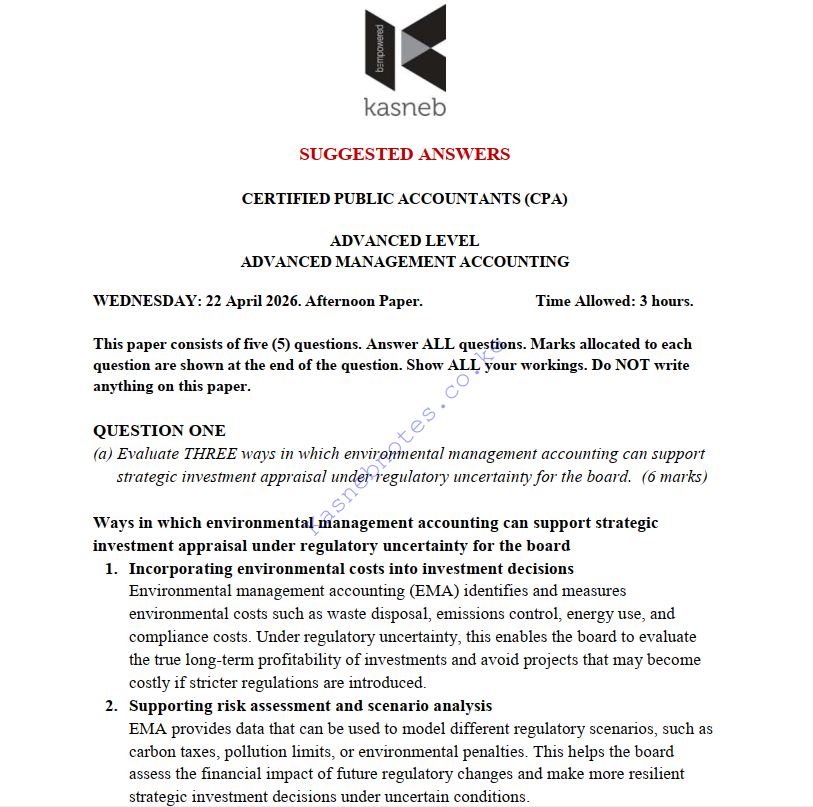
Original price was: KSh600.KSh499Current price is: KSh499.
Download April 2026 CPA Advanced Management Accounting Answers in Pdf form
Description
CERTIFIED PUBLIC ACCOUNTANTS (CPA) ADVANCED LEVEL
ADVANCED MANAGEMENT ACCOUNTING
WEDNESDAY: 22 April 2026. Afternoon Paper. Time Allowed: 3 hours.
This paper consists of five (5) questions. Answer ALL questions. Marks allocated to each question are shown at the end of the question. Show ALL your workings. Do NOT write anything on this paper.
QUESTION ONE
(a) Evaluate THREE ways in which environmental management accounting can support strategic investment appraisal under regulatory uncertainty for the board. (6 marks)
(b) Mambo Ltd. manufactures industrial packaging materials for export markets and faces increasing sustainability reporting obligations and possible carbon border adjustment taxes. Failure to proactively manage environmental costs may weaken long-term competitiveness and restrict access to environmentally sensitive markets.
The board is considering investing in a low-emission production facility to reposition the company strategically and mitigate future regulatory exposure. However, projected cash inflows depend on the regulatory environment that will prevail over the next five years.
Additional information:
1. Initial investment required is Sh.72,000,000.
2. Project life is five years with no residual value.
3. Cost of capital is 11%.
4. If strict carbon taxation is introduced (probability 0.4), annual net cash inflows will be Sh.28,000,000.
5. If moderate regulation applies (probability 0.35), annual net cash inflows will be Sh.18,000,000.
6. If no regulation is enacted (probability 0.25), annual net cash inflows will be Sh.9,000,000.
7. Present value of annuity factor for five years at 11% is 3.696.
Required:
(i) Calculate the expected net present value (ENPV). (6 marks)
(ii) Assess whether the project should be undertaken from both a financial and strategic perspective.
(8 marks)
(Total: 20 marks)
QUESTION TWO
(a) Summarise THREE strategic implications of implementing a just-in-time inventory system in an organisation operating under demand volatility and supplier lead-time uncertainty. (6 marks)
(b) Uwezo Equipment Ltd. assembles precision irrigation systems. The firm’s customer contracts require high service reliability, but the company experiences fluctuating demand driven by seasonal farming patterns and project-based procurement.
A critical component is imported, and supplier lead times are affected by shipping delays. Management is reviewing its ordering policy in order to minimise total relevant inventory cost while maintaining the required service level. A supplier has proposed a quantity discount, although accepting the discount would result in larger average inventories.
Assume that:
• Annual demand is known and constant for Economic Order Quantity (EOQ) purposes.
• Lead time is constant at four weeks.
• Demand during lead time is normally distributed.
• Safety stock is held only to achieve the required cycle-service level.
Additional information:
1. Annual demand is 80,000 units.
2. Ordering cost is Sh.4,000 per order.
3. Annual holding cost is Sh.180 per unit.
4. Purchase price is Sh.2,000 per unit.
5. A supplier offers a 5% discount for orders of 6,000 units or more.
6. Weekly demand standard deviation is 150 units.
7. Lead time is 4 weeks.
8. Desired service level is 97% (Z = 1.88).
9. There are 50 working weeks per year.
Required:
(i) Compute the economic order quantity (EOQ). (3 marks)
(ii) Calculate the total annual relevant cost under the EOQ policy and under the discount policy based on an order quantity of 6,000 units. In each case, include annual purchase cost, annual ordering cost and annual holding cost. Hence, advise management on whether the quantity discount should be accepted. (7 marks)
(iii) Using the standard deviation of demand during lead time derived from the weekly demand variability given above, compute the safety stock and the re-order level required to achieve the stated service level.
(3 marks)
(iv) Explain ONE limitation of applying the EOQ and service level-based safety stock model in this context.
(1 mark)
(Total: 20 marks)
QUESTION THREE
(a) Explain TWO measures commonly used to assess investment centres in a decentralised organisation, showing how each might influence managerial behaviour. (4 marks)
(b) Bora Ltd. operates Processing and Distribution divisions, both of which are treated as investment centres within a decentralised structure.
The Processing division manufactures an intermediate product that may either be sold to external customers or transferred internally to the Distribution division. The senior management is concerned that an inappropriate transfer price may encourage divisional managers to optimise divisional performance at the expense of overall company profitability.
Additional information:
1. The external market can absorb any output not transferred internally and the external market price is constant.
2. The Processing division has sufficient capacity to satisfy the Distribution division’s requirement.
3. All units transferred internally are processed and sold by the Distribution division in the same year.
4. The processing capacity is 600,000 units per annum.
5. The external selling price of the intermediate product is Sh.120 per unit.
6. The variable cost in processing is Sh.70 per unit while the annual fixed costs amount to Sh.30,000,000.
7. The Distribution division requires 400,000 units per annum.
8. Final selling price by Distribution is Sh.200 per unit.
9. Additional variable cost in Distribution is Sh.45 per unit.
10. Average operating assets of Processing are Sh.150,000,000.
11. For purposes of performance evaluation, in part (iii) divisional operating profits should be taken as divisional contribution less traceable fixed costs.
12. Required rate of return is 16%.
Required:
(i) Determine the minimum transfer price and the maximum transfer price per unit. (4 marks)
(ii) Assuming that the transfer price is set at the external market price, prepare in columnar form divisional operating statements for the Processing division, the Distribution division and the company as a whole. Comment on whether the resulting transfer price promotes goal congruence. (6 marks)
(iii) Using the market-price transfer assumption in part (b) (ii), calculate for the Processing division’s Return on investment (ROI) and Residual income (RI). Critically assess which of the two measures provides a more appropriate basis for performance evaluation in this case. (6 marks) (Total: 20 marks)
QUESTION FOUR
(a) Discuss TWO strategic benefits of integrating life cycle costing with target costing in the development of a technologically advanced product. (4 marks)
(b) Gari Motors Ltd. is developing a new electric commercial vehicle in response to tightening emission standards and increased fuel prices. Market research indicates significant price sensitivity and aggressive competitive entry within the next year. Management has adopted a target costing approach supported by learning curve analysis to ensure the product achieves its required profitability at launch. Since the assembly process involves new tooling and workforce training, labour efficiency is expected to improve during the early production stages.
Additional information:
1. Target selling price is Sh.14,000,000.
2. Target profit margin is 22% of selling price.
3. First unit requires 220 labour hours.
4. Direct labour rate is Sh.16,000 per hour.
5. Direct material cost per unit is Sh.5,000,000.
6. Variable production overhead is absorbed at Sh.5,000 per direct labour hour.
7. Fixed production overhead specifically attributable to the first eight units is budgeted at Sh.18,000,000 in total and is to be absorbed evenly over those eight units.
8. An 85% learning curve applies for the first eight units.
9. Learning index is –0.234.
Required:
(i) Calculate the target cost per unit. (3 marks)
(ii) Estimate the average labour time per unit for the first eight units and its implication for early-stage production planning. (5 marks)
(iii) Determine the expected average total cost per unit for the first eight units. (4 marks)
(iv) Evaluate the cost gap and recommend strategic actions management should prioritise before market launch.
(4 marks)
(Total: 20 marks)
QUESTION FIVE
(a) Describe FOUR stages involved in applying advanced budgetary control techniques in an organisation operating under high demand uncertainty and significant operational risk. (8 marks)
(b) Upishi Events Ltd. has secured an exclusive catering contract for a national outdoor festival. Management must decide in advance the number of premium food packages to prepare. Unsold packages will have no resale value after the event.
Based on historical patterns, the management estimates the following probabilities:
• Low demand: 0.3
• Moderate demand: 0.4
• High demand: 0.3
Estimated profit outcomes (Sh.) are shown below:
Demand condition 3,000 units 4,000 units 5,000 units 6,000 units
Low 4,000 2,000 (3,000) (6,000)
Moderate 6,000 9,000 11,000 8,000
High 8,000 12,000 16,000 20,000
Required:
(i) Determine the optimal decision using the Maximin and Maximax criteria. (4 marks)
(ii) Calculate the expected monetary value (EMV) for each decision alternative and identify the optimal decision.
(4 marks)
(iii) Computing the expected value of perfect information (EVPI), advise whether obtaining perfect demand information would be justified in principle. (4 marks)
(Total: 20 marks)
………………………………………………………………………
Related products
-
August 2024 CPA Advanced Public Financial Management Past papers with answers
Original price was: KSh600.KSh299Current price is: KSh299. Download -
August 2024 CPA Financial Reporting and Analysis Past Paper answers
Original price was: KSh300.KSh199Current price is: KSh199. Download -

Advanced Financial Management May 2015 Past Paper and Answers
Original price was: KSh399.KSh199Current price is: KSh199. Download -
August 2024 CPA CIFA Public Finance and Taxation Past Paper answers
Original price was: KSh300.KSh199Current price is: KSh199. Download