Original price was: KSh600.KSh399Current price is: KSh399.
Download April 2025 Boardroom Dynamics Past Paper answers in Pdf form
Description
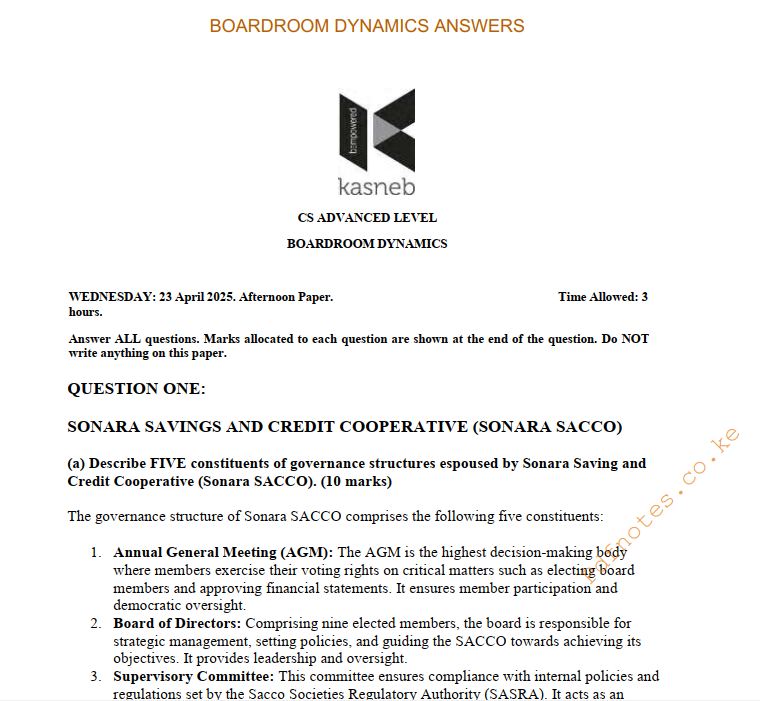
CS ADVANCED LEVEL BOARDROOM DYNAMICS
WEDNESDAY: 23 April 2025. Afternoon Paper. Time Allowed: 3 hours.
Answer ALL questions. Marks allocated to each question are shown at the end of the question. Do NOT write anything on this paper.
QUESTION ONE
SONARA SAVINGS AND CREDIT COOPERATIVE (SONARA SACCO)
Sonara Savings and Credit Cooperative (Sonara SACCO) is one of the fast-growing cooperative societies in Kenya, with tremendous growth witnessed in the last decade and a very varied membership basic from rural farmers to urban professionals. With assets in excess of Sh.5 billion, Sonara SACCO is a significant financial institution offering loans, savings plans and investment opportunities to its members. Recent governance challenges faced by diverse organisations where Sonara SACCO is not immune calls for the need for effective governance structures, transparent decision-making processes among others.
Sonara SACCO operates within the cooperative governance framework set forth by the Government of Kenya and adheres to the guidelines set by the Sacco Societies Regulatory Authority (SASRA). The governance structure of the SACCO comprises the annual general meeting (AGM), the board of directors, a supervisory committee and the management.
The AGM is the highest decision-making body where members vote on important decisions, including the election of board members and approval of financial statements. The Board of Directors, comprising nine elected members, is responsible for the strategic management of Sonara SACCO, while the Supervisory Committee ensures that internal policies and SASRA regulations are adhered to. The management team, headed by the Chief Executive Officer (CEO), is responsible for the day-to-day operations and the implementation of board decisions.
Despite the presence of a robust governance structure in Sonara SACCO, recent internal audits have uncovered several critical shortcomings including significant accountability gaps, the duplication of roles and a lack of clarity in communication between the board and management. These issues suggest that there remains considerable room for improvement in terms of alignment and cohesion within the governance framework. Such deficiencies indicate that, while the structure may be well-established, there are fundamental aspects of organisational synergy that require attention to ensure more effective and streamlined governance.
In early 2023, the board faced a critical decision regarding the introduction of a mobile lending facility aimed at providing members with more convenient access to financial services. Proponents of the initiative argued that it would not only attract a younger, tech-savvy demographic but also enhance operational efficiency. However, detractors raised concerns about the potential for elevated default rates and cyber security vulnerabilities. The decision-making process itself came under scrutiny, revealing several key issues. First, the feasibility studies conducted for the mobile lending platform were incomplete, leaving gaps in understanding its full implications. Second, certain board members lacked the necessary technical expertise to properly evaluate the proposal for a digital transformation, raising questions about the adequacy of the decision-making process. Lastly, suspicions arose regarding a potential conflict of interest, as one board member was found to have close ties with the technology vendor under consideration. This combination of inadequate research, lack of expertise and possible ethical concerns cast doubt on the integrity and soundness of the board’s decision-making approach.
The board finally delayed its decision to carry out a complete cost-benefit analysis. This setback showed flaws in the decision-making level, including consulting expert opinions and making policy guidelines on conflict-of-interest policies. The significant stakeholders for Sonara SACCO include members, regulators, employees and community partners. Any organisation has to engage with these groups to ensure that trust is maintained and to work toward its mission.
During the mobile lending debate, communications with the stakeholders were uneven. The enthusiasm of younger members about digital solutions brought frustration for the slow movement to implement the platform. Older members were concerned that a shift to digital lending would take the focus off traditional services thus, alienating members in rural areas.
In response to the growing concerns and divergent perspectives, the board decided to convene a series of stakeholder forums across its various branches. These forums provided invaluable insights, revealing a pronounced demand for digital solutions from urban members, who expressed eagerness for more advanced technological offerings. Conversely, rural members voiced concerns about the potential lack of inclusivity, highlighting the risk that digital platforms might not cater effectively to their needs. Additionally, there was a unanimous call from both urban and rural members for greater transparency in how major decisions were communicated and made. These findings underscored the importance of maintaining an ongoing, open dialogue with stakeholders, ensuring that their feedback is consistently integrated into the decision-making process to guide more informed and balanced strategic choices moving forward.
Historically, discussions within the Sonara SACCO boardroom were dominated by its senior members and took on an exclusively hierarchical nature, limiting innovative ideas and suggestions coming from younger, inexperienced board members. Additionally, suspiciousness and the infrequent development of personal scores also made a tense atmosphere preclusive of genuine, productive deliberation.
To address these challenges, the SACCO collaborated with a governance consultancy to cultivate a more collaborative and effective boardroom culture. Key interventions included conflict resolution training, workshops focused on promoting inclusivity and encouraging diverse viewpoints and leadership development programs designed to enhance the strategic thinking and emotional intelligence of board members. Within six months, the impact of these efforts became evident. Board meetings became more harmonious and productive, with members engaging in more innovative and forward-thinking discussions, signalling a noticeable improvement in the overall board dynamic.
Required:
(a) Describe FIVE constituents of governance structures espoused by Sonara Saving and Credit Cooperative (Sonara SACCO). (10 marks)
(b) Analyse FIVE inefficiencies in the board decision-making process Sonara SACCO. (10 marks)
(c) Evaluate FIVE benefits of building trust through stakeholder conversations in Sonara SACCO’s operations.
(10 marks)
(d) Explain FIVE challenges that Sonara SACCO faced in its boardroom culture. (10 marks)
(Total: 40 marks)
QUESTION TWO
(a) Explain TWO differences between “boardroom dynamics” and “board dynamics”. (4 marks)
(b) Describe SIX professional skills of an effective board member. (6 marks)
(c) Summarise FIVE benefits that an organisation could derive from conducting a board evaluation. (5 marks)
(Total: 15 marks)
QUESTION THREE
(a) Describe FIVE strategies for managing conflict within a board. (5 marks)
(b) Explain FIVE sources of power that might be exercised in the board. (5 marks)
(c) Assess FIVE determinants of directors’ remuneration. (5 marks)
(Total: 15 marks)
QUESTION FOUR
(a) Analyse FIVE strategies for promoting self-regulation in order to enhance corporate governance. (5 marks)
(b) Summarise FIVE techniques that could be adopted by a board to ensure behavioural agility. (5 marks)
(c) Evaluate FIVE challenges that organisations could face while creating board diversity. (5 marks)
(Total: 15 marks)
QUESTION FIVE
(a) Explain FIVE physical characteristics that impact boardroom dynamics. (5 marks)
(b) Using the model of influence developed by Cohen and Bradford, evaluate FIVE influence currencies that can be used to influence a board in a positive way. (5 marks)
(c) Discuss FIVE ethical dilemmas that boards encounter in relation to talent management. (5 marks)
(Total: 15 marks)
……………………………………………………………………………………………
Related products
-

- Collection of Management Principles and Practice Pdf Past Paper Answers (December 2021 to APRIL 2026)
Original price was: KSh1,200.KSh899Current price is: KSh899. Download -
- Collection of Communication Skills and Records Management Pdf Past Paper Answers (December 2021 to AUGUST 2025)
Original price was: KSh1,200.KSh799Current price is: KSh799. Download -
- Collection of Strategic Management Pdf Past Papers Answers (December 2021 to APRIL 2026)
Original price was: KSh1,200.KSh899Current price is: KSh899. Download -
August 2024 CPA Introduction to Law and Governance Past Paper answers
Original price was: KSh500.KSh299Current price is: KSh299. Download