Original price was: KSh600.KSh499Current price is: KSh499.
Download August 2025 Advanced Financial Management Answers in Pdf form
Description
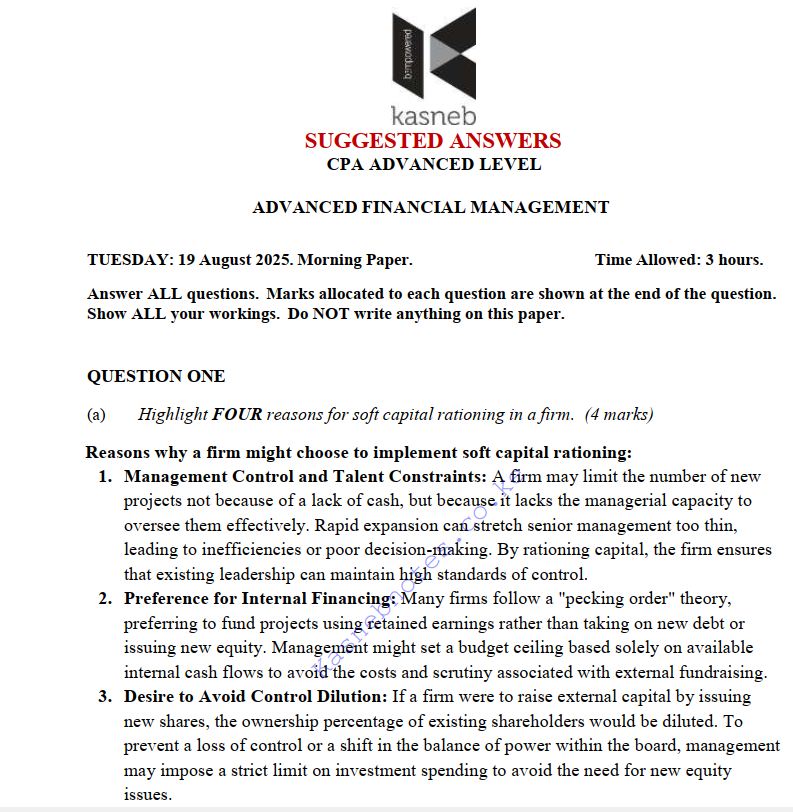
CPA ADVANCED LEVEL ADVANCED FINANCIAL MANAGEMENT
TUESDAY: 19 August 2025. Morning Paper. Time Allowed: 3 hours.
Answer ALL questions. Marks allocated to each question are shown at the end of the question. Show ALL your workings. Do NOT write anything on this paper.
QUESTION ONE
(a) Highlight FOUR reasons for soft capital rationing in a firm. (4 marks)
(b) Ushindi Ltd. is considering the following projects:
Project Initial outlay
Sh.“million” Annual revenue
Sh.“million” Annual fixed costs
Sh.“million” Project life
(Years)
A 100 200 50 3
B 300 300 100 5
C 150 180 60 4
D 120 170 80 10
E 180 80 20 15
Additional information:
1. Variable costs are 40% of annual revenue.
2. Each project is divisible.
3. Projects D and E are mutually exclusive.
4. Cash flows are confined within the lifetime of each project.
5. Cost of capital is 10%.
6. Ignore taxation and depreciation.
7. The company has a capital limitation of Sh.400 million for investment.
8. All cash flows occur at anniversary dates.
Required:
(i) Optional allocation of the available capital to the projects. (8 marks)
(ii) Maximum resultant Net Present Value (NPV) from the optimal allocation. (4 marks)
(c) Describe FOUR advantages Eurobond market offer over a domestic bond market that makes it an attractive way for companies to raise capital. (4 marks)
QUESTION TWO
(a) Modigliani and Miller contended that in a perfect capital market, the value of a company depended simply on its income stream and the degree of business risk attached to this regardless of the way in which its income was split between the owners and lenders.
Required:
With reference to the above statement, explain FIVE assumptions of Modigliani and Miller hypothesis. (5 marks)
(b) Securitisation has become an important tool in modern financial markets, enabling financial institutions to transform illiquid assets into tradeable assets.
Required:
In relation to the above statement, evaluate FIVE advantages of securitisation as a vehicle of financing real estate development in your country. (5 marks)
(c) Prime Actual Investors Limited have the following portfolio of four risky assets and have deposited in a risk free asset. The table shows portfolio weightings and the current asset returns together with their beta coefficients:
Asset Weightings (%) Current return (%) Beta
A 30 18 1.8
B 15 20 2.2
C 20 16 1.5
D 35 10 1.2
Risk free asset 30 8 0
The overall return on the market portfolio of risky assets is 12% and this is expected to continue for the foreseeable future.
Required:
(i) Compute the current return on the portfolio. (2 marks)
(ii) Ascertain the beta value of the portfolio. (1 mark)
(iii) Identify out of the four risky assets, the one(s) that are inefficient/efficient and super-efficient. (3 marks)
(iv) Based on the findings in (c) (iii) above, state the predictions that you would make regarding future asset values and their rates of return. (2 marks)
(v) Compute the equilibrium return on this portfolio assuming the weightings remain unchanged. (2 marks)
QUESTION THREE
(a) Explain FOUR factors leading to differences in cost of capital of domestic firms and multinational corporations (MNCs). (4 marks)
(b) Discuss FOUR challenges facing developing countries in establishing and operating derivatives market.
(4 marks)
(c) Suppose the Pound Sterling is bid at US dollars 1.9822 in New York, USA and the Euro is offered at US dollars 1.3517 in Frankfurt, Germany. At the same time Manchester Banks in United Kingdom are offering the Pound Sterling at 1.4582 Euros.
Required:
Show the steps an astute trader would follow to earn riskless profits through a triangular arbitrage.
Assume that the trader begins in New York with US dollars 1,050,000. (6 marks)
(d) Reno Limited is engaged in plastics manufacture. It is now considering a new investment that would involve diversification into chemical manufacturing, where the business risk is very different from the plastic manufacturing industry.
Research has produced the following information about three companies currently engaged in chemicals manufacturing, in the same part of the industry that Reno Limited is planning to invest.
Company Equity beta Financed by:
X 1.33 40% equity capital, 60% debt capital
Y 0.78 75% equity capital, 25% debt capital
Z 0.725 80% equity capital, 20% debt capital
Additional information:
1. Reno Limited is financed by 60% equity capital and 40% debt capital and would intend to maintain this same capital structure if the new capital investment is undertaken.
2. The risk free rate of return is 5% and the return on the market portfolio is 9%.
3. The corporation tax is at the rate of 30%.
4. Assume that the debt capital of Reno Limited and companies X, Y and Z is risk free.
Required:
(i) Calculate a suitable cost of equity for the proposed investment by Reno Limited in chemicals manufacturing. (4 marks)
(ii) Suggest a weighted average cost of capital (WACC) that should be used to carryout an investment appraisal (Net Present Value calculation) of the proposed project. (2 marks)
QUESTION FOUR
(a) Assess THREE ways in which block chain technology as an emerging issue in finance could contribute to financial inclusion in your country. (6 marks)
(b) KK Ltd. and JP Ltd. are companies operating in the same line of business. In the recent past, KK Ltd. has experienced very stiff competition from JP Ltd. such that KK Ltd., is considering acquiring JP Ltd. in order to consolidate its market share.
The following financial data is available about the two firms:
KK Ltd. JP Ltd.
Annual sales (Sh.“million”) 1,200 300
Net income (Sh.“million”) 450 60
Outstanding number of ordinary shares (million) 150 30
Earnings per share (Sh.) 3.0 2.0
Market price per share (Sh.) 60 30
Both companies are in the 30% income tax bracket
Required:
(i) Maximum exchange ratio that KK Ltd. should agree to if it expects no dilution in its post acquisition earnings per share (EPS). (3 marks)
(ii) KK Ltd.’s post acquisition EPS assuming the companies agree an offer price of Sh.45. (3 marks)
(iii) KK Ltd.’s post acquisition EPS assuming that for every 600 ordinary shares of JP Ltd.’s are exchanged for 10 units of 10% debentures of Sh.1,000 par value each. (3 marks)
(iv) The operating profit, Earnings Before Interest and Tax (EBIT) at point of indifference between earnings of the firm under the financing plans in (b) (ii) and (b) (iii) above. (3 marks)
(v) The EPS at the point of indifference between earnings of the firm under the financing plans in (b) (ii) and
(b) (iii) above. (2 marks)
QUESTION FIVE
(a) The following statement of financial position and statement of profit or loss relate to Tola Ltd. for the year ended 31 December 2024:
Tola Ltd.
Statement of financial position as at 31 December 2024:
Assets: Sh.“000” Liabilities and equity Sh.“000”
Cash 40,000 Accounts payable 500,000
Receivables 300,000 Notes payable 100,000
Inventories 400,000 Total current liabilities 600,000
Total current assets 740,000 Mortgage 400,000
Land and buildings 100,000 Debentures 600,000
Plant (Net book value) 500,000 Total long term liabilities 1,000,000
Equipment (Net book value) 800,000 Preference share capital (10,000 shares) 100,000
Total fixed assets 1,400,000 Ordinary share capital (50,000 shares) 100,000
Paid in capital 200,000
Retained earnings 140,000
Total shareholders equity 540,000
Total assets 2,140,000 Total liabilities and equity 2,140,000
Tola Ltd.
Statement of profit or loss for the year ended 31 December 2024:
Sh.“000”
Sales 600,000
Cost of goods sold (350,000)
Selling and administration expenses (100,000)
Earnings before interest and taxes (EBIT) 150,000
Interest (110,000)
Earnings before tax (EBT) 40,000
Corporation taxes at 30% (12,000)
Net income 28,000
The company’s ordinary shares are currently priced at Sh.4 per share.
Required:
(i) Using the Springate Model, assess the financial health of the company. (6 marks)
(ii) Other than the Springate Model, evaluate TWO other models of predicting corporate failure. (4 marks)
Note: The Springate model takes the following form:
Z = 1.03A + 3.07B + 0.66C + 0.4D
Where;
A = Net working capital Total assets
B = Operating profit
Total assets
C = Net profit before tax
Current liabilities
D = Sales
Total assets
(b) Mark Otieno who trades in shares at the Securities Exchange in the spot market follows the rule “When prices are rising#8211; Buy; when prices are falling#8211; Sell”. He ensures that his portfolio is intact at the end of every three months. He has a basic understanding that buy equates to call option and sell equates to put option. For a three-month period, he carried out trade in five listed companies as follows:
Company Spot price Three months expected price Exercise price
Sh. Sh.
Safariland 445 Increase by 20% 470
Absaland 415 Increase by 15% 450
CICD 395 Decrease by 10% 370
Jubila 380 Increase by 5% 390
KCIQ 405 Decrease by 15% 395
Additional information:
1. Assume that Mark Otieno only deals with 100 shares at a time.
2. Assume that Mark Otieno exercises his option.
Required:
(i) Compute the price of the shares and indicate the option chosen in each of the five companies. (3 marks)
(ii) Using appropriate computations, determine the gain or loss in each of the tradings in the above companies after three months. (7 marks)
Related products
-
August 2024 CPA Advanced Auditing and Assurance Past papers with answers
Original price was: KSh300.KSh199Current price is: KSh199. Download -
August 2024 CPA Advanced Management Accounting Answers
Original price was: KSh300.KSh199Current price is: KSh199. Download -
August 2024 CPA Advanced Financial Reporting and Analysis Answers
Original price was: KSh300.KSh199Current price is: KSh199. Download -
Advanced Financial Management May 2018 Past Paper and Answers
Original price was: KSh399.KSh199Current price is: KSh199. Download