Original price was: KSh500.KSh399Current price is: KSh399.
Download December 2025 Leadership and Management Answers in Pdf form
Description
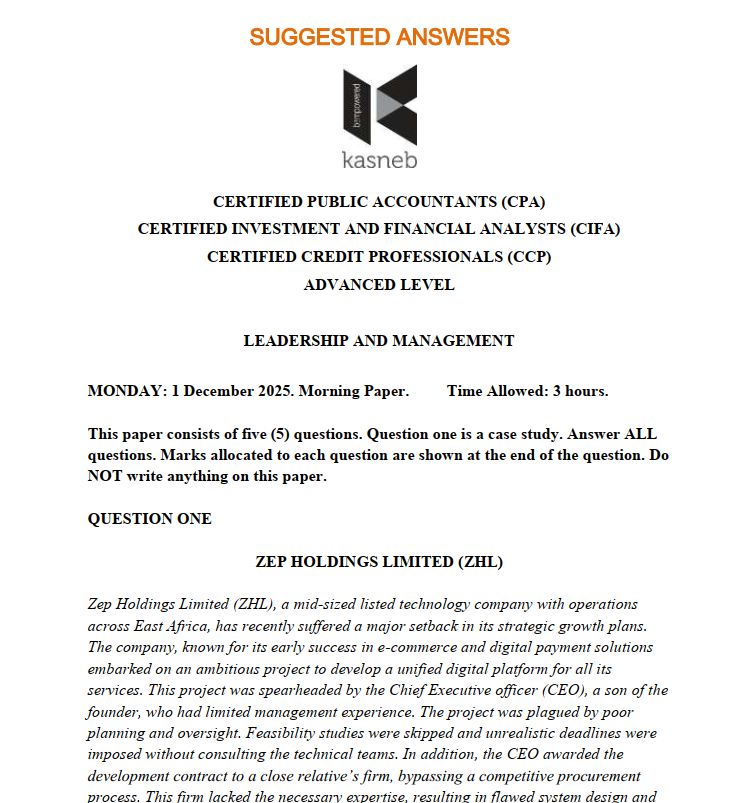
QUESTION ONE
ZEP HOLDINGS LIMITED (ZHL)
Zep Holdings Limited (ZHL), a mid-sized listed technology company with operations across East Africa, has recently suffered a major setback in its strategic growth plans. The company, known for its early success in e-commerce and digital payment solutions embarked on an ambitious project to develop a unified digital platform for all its services. This project was spearheaded by the Chief Executive officer (CEO), a son of the founder, who had limited management experience. The project was plagued by poor planning and oversight. Feasibility studies were skipped and unrealistic deadlines were imposed without consulting the technical teams. In addition, the CEO awarded the development contract to a close relative’s firm, bypassing a competitive procurement process. This firm lacked the necessary expertise, resulting in flawed system design and numerous implementation delays. Top management also ignored warnings from experienced project managers about rising risks, choosing to suppress bad news rather than address issues proactively.
After 18 months, the new platform’s launch was a failure. Customers experienced frequent system crashes and data errors, leading to frustration and public criticism on social media. Major corporate clients pulled out of pilot programmes, citing unreliability. Regulators intervened when it emerged that ZHL’s platform had not met several compliance requirements and the company was fined for these lapses. Internally, the project’s failure created turmoil. Employee morale hit an all- time low as staff grew cynical of leadership’s favouritism and disregard for professional input. Several talented developers and managers resigned, unwilling to work under what they perceived as a toxic, demotivating culture. The Board of Directors, chaired by the founder, had largely rubber-stamped the CEO’s decisions throughout the project. Board meetings were infrequent and superficial, offering little meaningful oversight or guidance. The lack of independent governance allowed the CEO’s errors to compound unchecked.
Facing mounting pressure from shareholders and regulators, ZHL announced a leadership shake-up. The CEO and a number of his close associates resigned. An interim Chief Operating Officer (COO) was appointed to stabilise the company. The board also brought in an external management consultant to assess the damage and chart a recovery path. The consultant’s report was frank: weak leadership, poor governance practices and the absence of stakeholder engagement were at the heart of ZHL’s troubles. The report recommended several turnaround strategies, including overhauling corporate governance by appointing independent directors, instituting transparent procurement and ethical compliance policies and rebuilding trust with clients and regulators through active stakeholder outreach. It also advised empowering competent middle managers to lead a thorough review of internal processes, from project management methodologies to quality control and risk management systems to prevent such failures in the future.
Early steps have been taken to implement these recommendations. Two independent directors with strong industry reputations have joined the board and a new Project Management Office (PMO) has been set up to introduce rigorous planning and monitoring for all major initiatives. Open forums with remaining employees have been held to solicit ideas and rebuild morale. Affected corporate clients were invited to provide feedback and ZHL has begun offering free remedial services to restore goodwill.
These initial actions have been received positively. Employee surveys show improving confidence in the new leadership and some clients express cautious optimism about the platform if promised fixes are delivered. The challenge now lies in institutionalising these changes across ZHL’s culture, processes and structure. Entrenched interests accustomed to the old way of doing business are quietly resistant. The interim COO knows that without careful change management, including clear communication, training and aligning incentives – the organisation may slip back into its old habits, jeopardising the nascent recovery. ZHL’s ability to learn from this failure and adapt will determine if it can regain its innovative edge and stakeholder trust in the coming years.
Required:
(a) Analyse the CEO’s leadership style resulting in failures at ZHL. Specifically, how did the CEO’s actions regarding the development contract violate the fundamental principle of a leader’s fiduciary duty. (8 marks)
(b) For each function of management you are aware of, outline evidence-based weakness of ZHL leadership.(10 marks)
(c) The project’s failure was compounded by organisational cultural issues.
(i) Describe THREE features of toxic organisational culture that developed under the old leadership of ZHL. (6 marks)
(ii) Using the principles of project management, identify TWO critical process failures the new Project Management Office (PMO) must immediately address. (4 marks)
(d) Discuss SIX effects of external environment pressures on unified digital platforms initiatives at ZHL.(12 marks)
(Total: 40 marks)
QUESTION TWO
(a) Explain FIVE strategic differences between leadership and management. (5 marks)
(b) Evaluate FIVE contributions of Mary Parker Follet to management of organisations in modern times. (10 marks)
(Total: 15 marks)
QUESTION THREE
(a) Discuss the application of Kotter’s 8-Step Model for leading change in an organisation of your choice. (7 marks)
(b) Examine FOUR factors influencing marketing strategies in an organisation of your choice. (8 marks)
(Total: 15 marks)
QUESTION FOUR
(a) Highlight FIVE benefits of participative leadership style in a service sector. (5 marks)
(b) Evaluate FIVE strategies through which transactional leadership could be effective in accomplishing short-term organisational objectives. (10 marks)
(Total: 15 marks)
QUESTION FIVE
(a) Explain SEVEN difficulties managers might face when forecasting to inform operational and strategic decision for a manufacturing firm. (7 marks)
(b) Examine FOUR competitive forces that exist in an organisation’s environment. (8 marks)
(Total: 15 marks)
Related products
-
Advanced Financial Management November 2019 Past Paper Answers
Original price was: KSh399.KSh199Current price is: KSh199. Download -
- CPA Advanced Financial Management (AFM) Year 2015 to 2019 Answers
Original price was: KSh999.KSh699Current price is: KSh699. Download -
August 2024 Advanced Financial Management Answers
Original price was: KSh300.KSh199Current price is: KSh199. Download -
Advanced Financial Management May 2019 Past Paper and Answers
Original price was: KSh399.KSh199Current price is: KSh199. Download